Huey Airmobile
Full Content FreeAugust 20, 2026
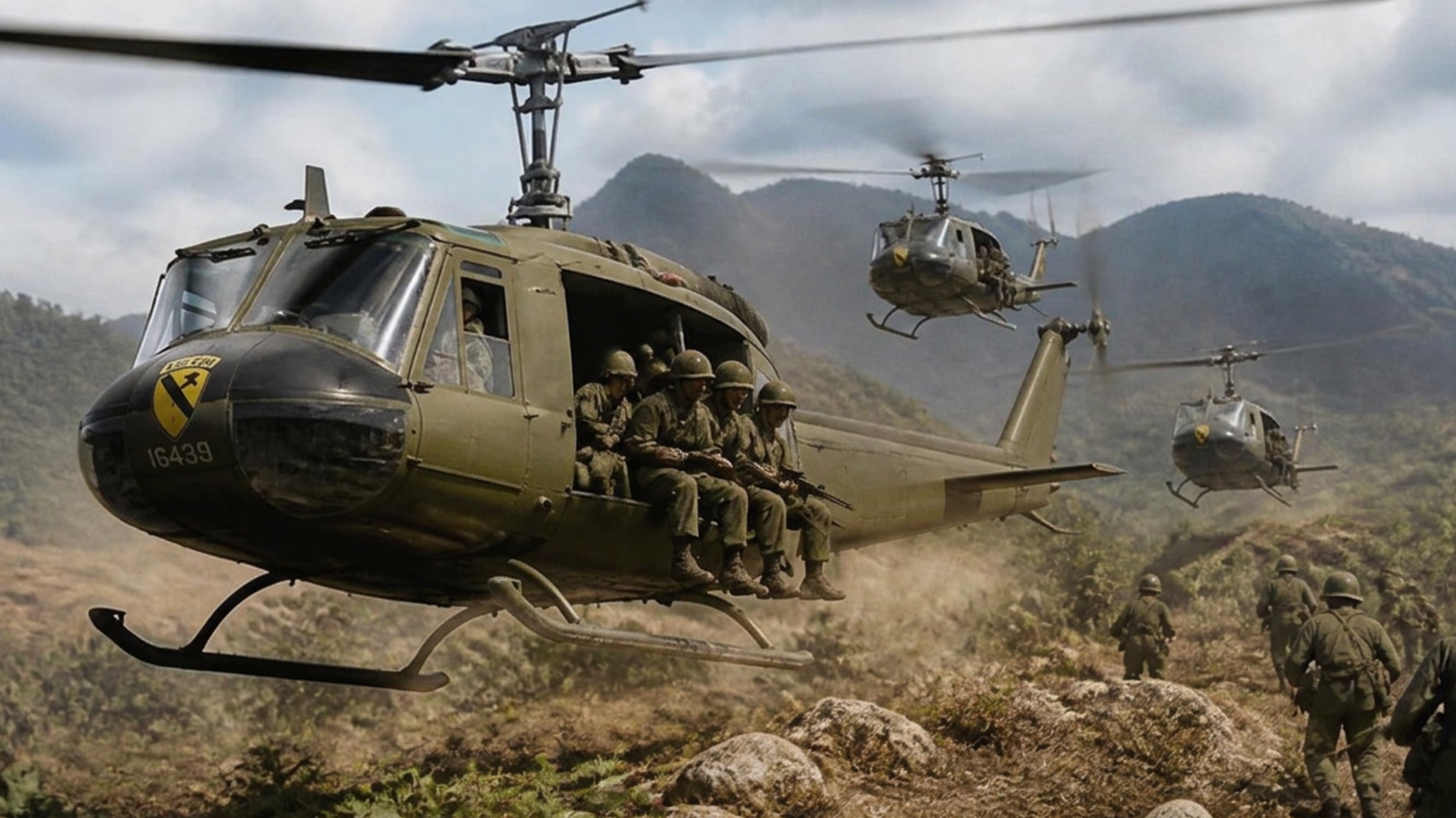
The Bell UH-1 Iroquois: How the "Huey" Revolutionized Modern Warfare
Pantheon Battles.AI | Tactical Systems Analysis
Introduction: The Sound of a New Era
There is perhaps no sound more evocative of modern warfare than the distinctive whop-whop-whop of rotor blades cutting through humid jungle air. Before the Bell UH-1 Iroquois — universally known as the "Huey" — military commanders thought of the helicopter as a useful tool for medical evacuation and reconnaissance. After it, they thought differently about nearly everything. The Huey did not merely improve upon existing battlefield doctrine. It shattered it entirely, forcing militaries around the world to reimagine the fundamental nature of ground combat, logistics, fire support, and troop projection.
To understand the Huey is to understand one of the most consequential technological inflection points in military history — a moment when a single platform catalyzed an entirely new philosophy of war.
Origins: From Medevac Dreams to Tactical Reality
The story begins in the aftermath of the Korean War. The conflict on the Korean Peninsula had demonstrated, for the first time at scale, that helicopters could pluck wounded soldiers from the battlefield and deliver them to surgical care within minutes — a capability that demonstrably saved lives. But military planners and visionary officers began asking a more ambitious question: If a helicopter can move a wounded man, what else can it move? And what can it do while it's moving?
The U.S. Army issued a requirement in 1952 for a new utility turbine helicopter — one powered not by the heavy, unreliable piston engines of the era, but by the lighter, more powerful turboshaft technology then emerging from the aviation industry. The requirement called for a machine capable of medical evacuation, instrument training, and general utility transport.
Bell Helicopter answered the call.
The XH-40 Prototype
In 1955, Bell flew the XH-40, a sleek, purposeful machine built around the Lycoming T53 turboshaft engine. The Army was immediately impressed. Here was a helicopter that was faster, more reliable, more powerful, and far simpler to maintain than the piston-driven machines it would replace. The Army ordered it into production as the HU-1A Iroquois — and it was that HU-1 designation that gave birth to the legendary nickname. Mechanics and crews simply called it the Huey, and the name never left.
In 1962, the Army redesignated the aircraft family as the UH-1 under the new unified designation system, but by then "Huey" was already permanently embedded in the military lexicon. No one called it anything else.
The Machine Itself: Engineering That Changed History
Before examining tactics and variants, it is worth pausing to appreciate why the Huey was such a revolutionary platform from a pure engineering standpoint. Its capabilities were not accidental — they were the product of deliberate design choices that made the aircraft uniquely suited for the fluid, demanding nature of combat operations.
The Turboshaft Advantage
The Lycoming T53 turboshaft engine was the Huey's beating heart, and its implications were enormous. Compared to piston engines, the turboshaft offered:
- Superior power-to-weight ratio — more lift capacity without a heavier airframe
- Greater reliability — fewer moving parts, less susceptibility to combat damage and mechanical failure
- Faster response — turbine engines could be brought to operating power more quickly
- Reduced maintenance burden — critical in field environments where spare parts and skilled mechanics were limited
This engine gave the Huey a cruise speed of approximately 125 mph (109 knots), a service ceiling of roughly 12,600 feet, and a range of approximately 300 miles under standard conditions. In the context of the mid-1950s rotary-wing world, these were remarkable numbers.
The Airframe: Simplicity as Doctrine
The Huey's semi-monocoque fuselage was deliberately simple and modular. The wide, sliding side doors allowed for rapid loading and unloading of troops, stretchers, cargo, and weapons systems. The cabin could be reconfigured quickly — from troop transport to medevac to gunship configuration — with a speed that no fixed-wing aircraft could match.
The two-blade semi-rigid rotor system was another signature element. It was that rotor design — specifically the interaction of the blade tips at certain advance ratios — that produced the iconic rhythmic thump that became the acoustic signature of the Vietnam War.
Enter Vietnam: The Laboratory of Airmobile Doctrine
The Huey entered combat in Vietnam in 1962, initially with U.S. Army advisors supporting South Vietnamese forces. What followed over the next decade was one of the most intensive periods of tactical experimentation and doctrinal evolution in military history. Vietnam was not simply a war where the Huey was used — it was the crucible in which airmobile warfare was forged.
The Howze Board and the Airmobile Concept
In 1962, the Army convened the Tactical Mobility Requirements Board, commonly known as the Howze Board after its chairman, Lieutenant General Hamilton Howze. The board's mandate was to evaluate whether aviation assets — particularly helicopters — could fundamentally transform Army tactical operations.
The conclusions were radical for their time. The board recommended the creation of air assault divisions — formations in which helicopters would serve not as support assets but as the primary means of tactical movement. Troops would not march to the fight or ride in trucks. They would fly to it, delivered with precision to positions that terrain, distance, or enemy action would otherwise make unreachable.
This concept was tested in the 11th Air Assault Division (Test), and the results were compelling enough that the Army moved forward with the activation of the 1st Cavalry Division (Airmobile) in 1965 — a formation that would deploy to Vietnam almost immediately and prove the concept in brutal, costly, and ultimately historic combat.
The Battle of Ia Drang Valley, November 1965
If any single engagement validated the airmobile concept and cemented the Huey's place in military history, it was the Battle of Ia Drang Valley in November 1965 — the first major engagement between U.S. Army forces and regular North Vietnamese Army (NVA) units.
The 1st Cavalry Division's troopers were inserted, resupplied, reinforced, and — when necessary — extracted entirely by helicopter. At Landing Zone X-Ray, UH-1s delivered Lieutenant Colonel Hal Moore's battalion directly into the killing ground of the Ia Drang in multiple lifts. When the battle erupted in ferocious close combat, it was the Huey that brought reinforcements, evacuated the wounded under fire, and delivered critical resupply runs that kept the battalion fighting.
The battle demonstrated several revolutionary principles simultaneously:
- Vertical envelopment — the ability to place forces on or near objectives regardless of ground obstacles
- Responsive fire support — armed Hueys could provide immediate suppressive fire during insertions and extractions
- Operational reach — airmobile forces could strike deep into territory previously considered unreachable
- Tactical flexibility — commanders could shift forces across the battlefield at speeds that ground-bound opponents simply could not counter
The NVA fought with extraordinary courage and tactical skill at Ia Drang, but they were dealing with a kind of warfare they had never encountered. The helicopter had fundamentally changed the relationship between geography and military power.
The Huey Family: Variants That Defined an Era
One of the Huey's greatest strengths was its adaptability. The platform evolved continuously throughout its service life, producing a family of variants that covered an extraordinary range of tactical functions.
UH-1A / UH-1B — The Pioneering Variants
The UH-1A was the initial production model, entering Army service in 1959. It carried a crew of two and could transport up to three passengers or two litters. It was underpowered by later standards — the T53-L-1A engine produced 770 shaft horsepower — but it established the basic architecture that all subsequent variants would build upon.
The UH-1B represented a significant leap forward. With an uprated T53-L-11 or L-13 engine producing up to 1,100 shaft horsepower, it offered meaningfully improved performance and payload capacity. The B model also became the first armed Huey variant, equipped with a variety of weapons configurations that planted the seed of the dedicated attack helicopter concept.
Early armament on the UH-1B included:
- Twin M60 machine guns in door-mounted configurations
- 2.75-inch Folding Fin Aerial Rockets (FFARs) in pod-mounted launchers
- 40mm grenade launchers
- Various combinations of forward-firing and crew-served weapons
These armed UH-1Bs became known as "Hogs" when configured primarily with rockets, and "Frogs" or "Cobras" (before the dedicated AH-1 Cobra) in mixed configurations. They flew the dangerous escort role during troop insertions and extractions, orbiting landing zones and suppressing enemy fire — a mission that would eventually evolve into the dedicated attack helicopter concept.
UH-1C — The Dedicated Gunship Variant
As combat experience accumulated in Vietnam, it became clear that the armed UH-1B was struggling in the gunship role. The problem was fundamental: the same airframe was being asked to perform both the utility transport role (with a relatively heavy, high-drag fuselage optimized for cargo) and the gunship role (which demanded speed, maneuverability, and the ability to carry heavy weapons loads simultaneously).
The UH-1C was the Army's solution — a variant purpose-built for the armed escort and fire support role. It featured an uprated T53-L-13B engine producing 1,100 shaft horsepower, a wider-chord rotor designed to improve performance at higher gross weights, and strengthened hard points for weapons pylons.
The UH-1C could carry combinations of:
- XM-21 armament subsystems (7.62mm miniguns and 2.75-inch rocket pods)
- M5 40mm grenade launcher systems
- XM-22 TOW missile systems (in later configurations, foreshadowing the anti-armor gunship role)
The C model gunship flew the dangerous "gun run" — making repeated diving passes on enemy positions during troop insertions, accepting fire to protect the more vulnerable troop-carrying slicks. It was hazardous, demanding flying that required extraordinary skill and courage, and the crews who flew these missions developed a professional culture and ethos all their own.
UH-1D — The Workhorse of Vietnam
If the UH-1B was the pioneer and the UH-1C was the gunship, the UH-1D was the true workhorse of the Vietnam War — the variant most Americans picture when they think of the Huey.
The D model featured a stretched fuselage that dramatically expanded cabin capacity. Where the B model could carry roughly four to six troops depending on equipment, the D model could carry up to 12 fully equipped soldiers or 6 litter patients, with significantly increased cargo capacity as well. This was achieved through a 41-inch fuselage extension and an uprated Lycoming T53-L-13 engine.
The UH-1D became the backbone of the airmobile division's assault lift capability. In Vietnam, formations of D models — flying in carefully choreographed serial formations — could insert an entire infantry company into a landing zone in a matter of minutes. The logistics implications were equally profound: resupply missions that would have taken days by ground could be accomplished in hours, maintaining the operational tempo that the airmobile concept demanded.
The D model was also the primary medevac platform — designated the HU-1D in the medical evacuation role and operated by crews who became legendary for their willingness to fly into hot landing zones to recover wounded soldiers. The medevac crews, operating under the distinctive Red Cross markings (and frequently under fire regardless), reduced the time from wounding to surgical care to a median of under 30 minutes in many cases — a medical achievement that produced survival rates dramatically higher than any previous conflict.
UH-1H — The Definitive Production Variant
The UH-1H represented the final major evolutionary step in the single-engine Huey family and became the most produced variant in the entire UH-1 series, with over 5,000 examples delivered to the U.S. military alone.
The H model's key improvement was the installation of the Lycoming T53-L-703 engine producing 1,400 shaft horsepower — a substantial increase over earlier variants that provided meaningfully better hot-and-high performance, critical in the mountainous regions of Vietnam and in the demanding conditions of potential European or Middle Eastern operations.
The UH-1H became the standard utility helicopter of the U.S. Army through the 1970s and into the 1980s, serving in every conceivable role from assault transport to command and control to electronic warfare. It was also exported widely, serving with dozens of nations around the world and forming the backbone of many allied air assault forces.
UH-1N Twin Huey — The Twin-Engine Evolution
As operational requirements grew more demanding — particularly in terms of over-water operations, single-engine-failure safety margins, and high-altitude performance — Bell developed the UH-1N, powered by a Pratt & Whitney Canada T400-CP-400 twin-pack turboshaft system effectively combining two PT6 engines.
The twin-engine configuration provided significantly improved safety margins, particularly for operations over water or in terrain where autorotation to a safe landing area was problematic. The UH-1N served primarily with the U.S. Marine Corps and the U.S. Air Force, filling roles from VIP transport to special operations support.
AH-1 Cobra — The Huey's Attack Helicopter Legacy
No discussion of Huey variants would be complete without acknowledging the platform's most significant evolutionary offshoot: the Bell AH-1 Cobra, which entered service in 1967.
The Cobra was not technically a UH-1 — it was a new aircraft that used the Huey's powerplant, rotor system, and transmission mated to a completely new, purpose-built attack airframe featuring a narrow fuselage, stepped tandem seating, and significantly enhanced weapons carrying capability. But it was the direct conceptual and mechanical descendant of the armed Huey gunship, representing the maturation of the lessons learned in thousands of hours of combat escort flying.
The Cobra's arrival freed the UH-1C to be phased out of the dedicated gunship role and allowed the development of true hunter-killer helicopter tactics — paired Cobra gunships working with OH-6 Cayuse scout helicopters in the "Pink Team" and "Heavy Pink Team" configurations that became standard air cavalry practice.
This lineage continued through the AH-1S, AH-1W SuperCobra, and ultimately the AH-1Z Viper still serving with the Marine Corps today — all of them Huey grandchildren in a very real sense.
Combat Tactics: The Art of Airmobile Warfare
The introduction of the Huey into combat did not merely add a new weapon to the military's arsenal. It required the development of entirely new tactical doctrine, procedures, and techniques — many of them invented under fire by the soldiers and aircrews who had no manual to consult because the manual had not yet been written.
The Combat Assault
The combat assault was the defining tactical operation of airmobile warfare — the coordinated insertion of infantry forces into a landing zone, typically opposed, using multiple helicopters operating in concert.
A typical combat assault involved several distinct phases:
1. Planning and Briefing The assault began hours or days before the first rotor turned. Intelligence, weather, landing zone selection, route planning, fire support coordination, and alternate plans all had to be developed and disseminated. The complexity of coordinating multiple aircraft, artillery, tactical air support, and ground forces demanded staff work of considerable sophistication.
2. Preparation of the Landing Zone (LZ Prep) Before the assault aircraft arrived, the landing zone would typically be subjected to preparatory fires designed to suppress or destroy enemy forces in and around it. This might include:
- Artillery fires from supporting battery positions
- Tactical air strikes from fixed-wing aircraft
- Gun runs by escorting UH-1C or AH-1 gunships
- Naval gunfire where applicable
The goal was to suppress enemy air defense weapons — particularly the anti-aircraft machine guns and rifle fire that posed the primary threat to low, slow helicopters on final approach.
3. The Approach and Insertion The assault aircraft — typically UH-1Ds or Hs carrying infantry "sticks" of six to eight troops — flew to the LZ in serial formation, with multiple aircraft approaching simultaneously to minimize the time of exposure during the critical landing phase. Lead ships landed first while trail ships orbited, then landed in rapid succession.
Time on the ground was measured in seconds. Troops disembarked while rotors were still turning, sprinting away from the aircraft to clear the LZ and begin establishing a defensive perimeter. Aircraft lifted and departed immediately, clearing the LZ for subsequent lifts.
4. Escort and Suppression Throughout the approach, landing, and departure, armed helicopters orbited or made gun runs to suppress enemy fires. The coordination between assault aircraft and their escorts was intricate and practiced — gun runs had to avoid the flight paths of the assault aircraft, suppression had to be lifted at the precise moment troops were disembarking, and the orbiting pattern had to provide continuous coverage without putting multiple aircraft in conflict.
5. Extraction The reverse procedure — extracting troops from a contested position — was often more dangerous than insertion. Enemy forces had frequently identified the pickup zone and could place accurate fire on aircraft during the critical seconds of landing. Extraction techniques evolved rapidly to minimize exposure, including the use of McGuire rigs and later STABO harnesses for the rapid extraction of troops from positions where a helicopter could not land at all.
The Medevac Mission: "Dustoff"
No tactical role better illustrated the Huey's transformative impact on warfare than the medical evacuation mission, known by the call sign "Dustoff" — a name derived from the call sign of Major Charles Kelly, one of the first dedicated medevac pilots who was killed in action in 1964.
The Dustoff crews operated under a set of principles that were as tactically revolutionary as they were morally significant:
- Medevac aircraft flew to recover wounded soldiers regardless of weather, time of day, or enemy activity
- They operated under the Geneva Convention's Red Cross markings — which afforded them no practical protection but imposed clear moral and legal obligations
- They maintained a 24-hour immediate response posture
- They flew directly into active firefights when necessary to recover the wounded
The statistical impact was staggering. In World War II, approximately 4.5 soldiers died of wounds for every 100 casualties. In Korea, that number dropped to roughly 2.5. In Vietnam, despite the intensity and lethality of combat, the figure fell below 1.5 — a reduction directly attributable to the speed with which the Huey could deliver wounded men to surgical care.
The psychological impact on the infantry was equally significant. The knowledge that if you were hit, a helicopter would come for you — regardless of circumstances — fundamentally altered the fighting man's relationship with risk and his trust in the institutions he served. This was not a small thing. It was a force multiplier measured not in firepower but in morale and commitment.
Air Cavalry Operations: Reconnaissance and Exploitation
The air cavalry concept represented one of the most innovative tactical applications of the Huey family. Air cavalry units, organized around a combination of observation helicopters (initially the OH-13 Sioux and later the OH-6 Cayuse and OH-58 Kiowa), armed Huey gunships, and assault Hueys, operated as combined arms teams of extraordinary agility and lethality.
The standard air cavalry reconnaissance element was the "Pink Team":
- One OH-6 "Loach" scout helicopter flying low and slow to locate enemy forces
- One UH-1C (later AH-1 Cobra) gunship orbiting high to provide immediate fire support when the scout made contact
The scout's job was inherently dangerous — it flew low enough to draw enemy fire, which would then reveal enemy positions to the gunship above. Crews understood this was the mission. The gunship would then engage while the scout marked targets, directed fires, and maintained contact. It was a form of aerial combined arms warfare that had no precedent in military history.
When a significant enemy force was located, the "White Team" scout elements could request the commitment of assault helicopters to insert infantry — completing the find-fix-finish cycle with a speed that ground-based forces simply could not replicate.
Command and Control from the Air
The Huey also transformed command and control at the brigade and division level. Senior commanders — from battalion to division level — routinely flew in command and control Hueys, providing them with real-time situational awareness over the battlefield that no ground commander in history had ever possessed.
This had both benefits and drawbacks. The benefit was clear: commanders could see the battlefield, redirect forces, coordinate fires, and maintain situational awareness with unprecedented fidelity. The drawback, as experience eventually revealed, was the tendency for commanders to micromanage from above, disrupting the initiative of small unit leaders and sometimes making tactical decisions from altitude with incomplete information about conditions on the ground.
This tension between aerial command and ground-level reality became one of the enduring lessons of airmobile warfare — one that subsequent doctrine would spend decades attempting to resolve.
Limitations and Vulnerabilities: The Honest Ledger
No analysis of the Huey's combat impact would be complete without an honest accounting of its limitations and the tactical problems those limitations created.
Vulnerability to Ground Fire
The Huey was not an armored aircraft. Its thin aluminum skin provided virtually no protection against small arms fire, and the critical components — engine, tail rotor, hydraulics — were exposed to damage from even relatively light weapons. A single well-placed rifle shot could bring down a Huey.
In Vietnam, enemy forces adapted quickly to the airmobile threat, concentrating anti-aircraft fire on landing zones and approach corridors. The 12.7mm DShK heavy machine gun was a particularly lethal threat, capable of engaging helicopters at ranges and altitudes that made avoidance extremely difficult. Later in the war, SA-7 Grail man-portable surface-to-air missiles introduced an entirely new dimension of threat that the Huey's speed and altitude envelope made it poorly positioned to defeat.
Performance Limitations in Hot-and-High Conditions
The Huey's performance degraded significantly in the conditions — high altitude, high temperature — that characterized operations in the Central Highlands of Vietnam and that would characterize potential operations in European or Middle Eastern theaters. Fully loaded aircraft operating at altitude on hot days were sometimes unable to achieve effective translational lift, forcing crews to dump fuel or reduce troop loads.
This limitation drove continuous engine upgrades and eventually contributed to the development of the UH-60 Black Hawk as the Huey's eventual successor in the assault transport role.
Noise and Signature
The Huey's distinctive acoustic signature — audible at considerable distance under favorable atmospheric conditions — provided enemy forces with early warning of approaching helicopters, allowing them to prepare ambushes, disperse, or take cover before the aircraft arrived. This was not a problem that engineering could fully solve; it was an inherent characteristic of the rotary-wing aircraft's acoustic physics.
Tactical responses included nap-of-the-earth (NOE) flying — exploiting terrain features to mask the sound signature and reduce radar cross-section — but this technique had its own risks, including the ever-present danger of wire strikes and terrain collision at low altitude and high speed.
Legacy: The World the Huey Built
The Bell UH-1 Iroquois served in the armed forces of over 80 nations and accumulated a production run of more than 16,000 aircraft — making it one of the most produced military helicopters in history. It served in Vietnam, the Falklands, the Gulf War, the Balkans, Afghanistan, Iraq, and dozens of smaller conflicts around the world. Many examples remain in active military or civil service today, more than six decades after the type's first flight.
But the Huey's legacy transcends its production numbers or its service record. What the Huey created was a new doctrine of warfare — one built on speed, vertical reach, and the aggressive integration of rotary-wing aviation into every aspect of ground operations. The principles developed in the paddies and jungles of Vietnam — air assault, air cavalry operations, aeromedical evacuation, helicopter-borne command and control — remain foundational to U.S. Army doctrine today.
The 82nd Airborne Division, the 101st Airborne Division (Air Assault), the 160th Special Operations Aviation Regiment ("Night Stalkers"), and the Army's broader aviation branch all trace their conceptual lineage, in significant part, to the lessons learned by the men who flew Hueys over the Ia Drang, the A Shau Valley, and a hundred other engagements whose names are carved in the memory of a generation.
The Black Hawk replaced the Huey in the assault transport role. The Apache replaced it in the attack role. The Kiowa eventually retired from the scout role. But all of them operate according to a doctrine of airmobile warfare that the Huey made possible — forged in combat by soldiers and aircrews who took an innovative aircraft, brought it into the most demanding possible operational environment, and used it to fundamentally change the nature of war.
Conclusion: A Platform That Earned Its Place in History
The Bell UH-1 Iroquois was not the fastest aircraft, the most powerful, or the most sophisticated. What it was — at exactly the right moment in military history — was reliable, adaptable, capable, and available in numbers sufficient to change doctrine.
The most important revolutions in military history are rarely those of the most spectacular weapons. They are the revolutions of systems thinking — moments when a new technology enables a new way of operating that renders previous approaches obsolete. The Huey was that kind of revolution.
It gave armies vertical envelopment. It gave wounded soldiers a fighting chance at survival. It gave commanders a view of the battlefield no general in history had ever possessed. And it did all of this not in some future theoretical conflict, but in the furnace of actual war, flown by men who wrote the doctrine in their own blood and the blood of those they carried.
The whop-whop-whop of the Huey's rotor blades was not merely the sound of a helicopter. It was the sound of warfare being reinvented.
Pantheon Battles.AI — Where Military History Meets Strategic Intelligence
Sources and Further Reading: Hal Moore & Joseph Galloway, "We Were Soldiers Once... And Young" | John Tolson, "Airmobility 1961-1971" | U.S. Army Aviation Center historical archives | Bell Helicopter historical documentation | Vietnam War After-Action Reports, National Archives