Armor & Tanks: A Century of Armored Warfare — Full Analysis
Full Content FreeAugust 22, 2026
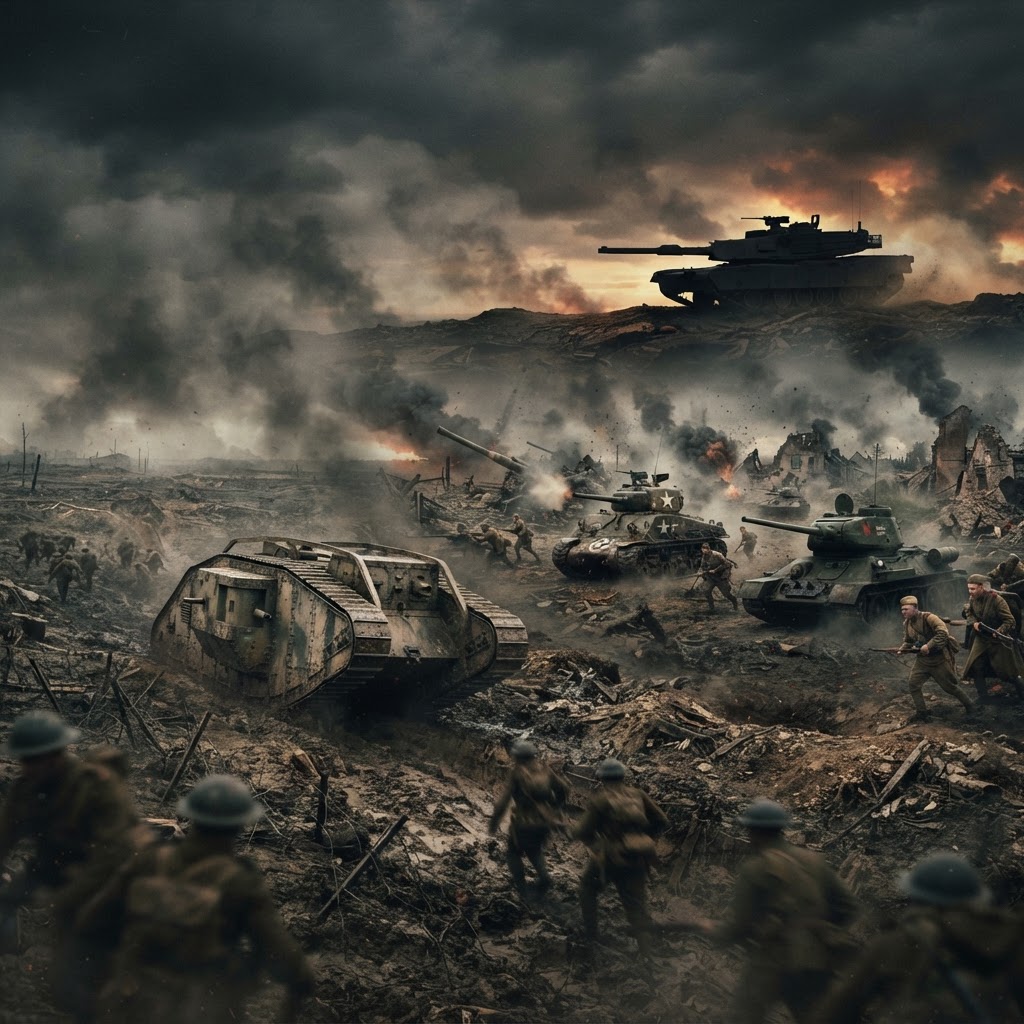
Armor & Tanks: A Century of Armored Warfare
Executive Summary
For more than a century, the tank has stood as the ultimate expression of the modern military trinity: firepower, mobility, and protection. Born in the mud of the Somme in 1916, armored vehicles evolved from slow, unreliable steel boxes into the networked, thermally-sighted, composite-armored main battle tanks (MBTs) that dominate land warfare today. This analysis traces the complete arc of armored warfare across six eras — from World War I through the interwar doctrinal revolution, the great tank battles of World War II, the Cold War consolidation of the MBT concept, the digital-networked modern era, and the current crucible of drone-and-missile warfare in Ukraine. It examines key technological innovations (sloped armor, composite armor, explosive reactive armor, active protection systems), decisive doctrinal shifts (infantry support to Blitzkrieg to combined-arms networked warfare), iconic platforms that defined each generation, and the existential question now facing armored forces: in an age of ubiquitous anti-tank guided missiles (ATGMs), loitering munitions, and first-person-view (FPV) drones, does the tank still have a future?
I. Strategic & Political Context: Why the Tank Was Born
The tank was the direct product of a strategic crisis — the stalemate of trench warfare on the Western Front (1914–1918). By 1915, the Western Front had solidified into a continuous belt of fortifications stretching from the English Channel to Switzerland. Machine guns, barbed wire, and artillery made traditional infantry assaults suicidal. The Battle of the Somme (1916) produced over one million casualties for gains measured in miles.
Simultaneously, the industrial capacity of the belligerent powers was expanding. Tractor technology, track-laying vehicles, and internal combustion engines were maturing. The British Landships Committee, formed in February 1915 under First Lord of the Admiralty Winston Churchill, began developing a tracked, armored vehicle capable of crossing trenches, crushing barbed wire, and resisting small-arms fire. The French, working independently under Colonel Jean-Baptiste Estienne, pursued a parallel program. Both nations understood that the war would be won not by static defense but by the restoration of maneuver — and that required a machine that could survive the killing ground of no-man's-land.
II. Order of Battle: Key Platforms Across Six Generations
World War I (1916–1918)
- British Mark I (28 tons, 8 crew): First tank in combat, Battle of Flers-Courcelette, Sept. 15, 1916. "Male" variant carried two 6-pounder naval guns; "Female" carried machine guns. Of 49 deployed, only 25 reached start lines due to mechanical failures.
- Renault FT-17 (6.7 tons, 2 crew): Revolutionary design with rotating turret, rear-mounted engine, forward crew compartment — the template for all future tank design. France produced nearly 4,000.
- Mark IV (29 tons): 1,220 built; primary British tank of 1917–1918.
- Britain produced ~2,800 tanks during WWI; France ~4,000. Germany built only 20 A7Vs.
Interwar (1919–1939)
- Panzer III (22 tons, 37mm/50mm): Germany's primary anti-tank platform; backbone of Panzer divisions.
- Panzer IV (25 tons, 75mm): Originally infantry support; evolved into Germany's workhorse.
- BT-7 (13.8 tons, 45mm): Soviet fast tank based on Christie suspension; precursor to T-34.
- Vickers 6-Ton: British export design; basis for Soviet T-26 and Polish 7TP.
- Char B1 bis (31.5 tons): Heavily armored French tank; suffered from poor tactical employment.
Doctrinal revolution: Germany, barred by Versailles from possessing tanks, secretly studied armored warfare through Soviet cooperation at the Kazan tank school (1929–1933). Heinz Guderian's Achtung — Panzer! (1937) articulated concentrated armored spearheads supported by motorized infantry and close air support — Blitzkrieg. Britain split tanks into slow "infantry tanks" and fast "cruiser tanks." France distributed tanks in "penny packets" across infantry divisions. The USSR developed "deep battle" under Tukhachevsky.
World War II (1939–1945)
- T-34 (26–32 tons, 76.2mm or 85mm): ~84,000 produced. Sloped armor, wide tracks, Christie suspension, mass-produced — the war's most influential tank.
- M4 Sherman (30.3 tons, 75mm/76mm): ~49,000 produced. Reliable, mass-producible, logistics-friendly.
- Panzer IV Ausf. G/H/J (25 tons, 75mm KwK 40): ~8,500 produced. Germany's most-produced tank.
- Tiger I (57 tons, 88mm): 1,347 built. Devastating firepower; over-engineered and expensive.
- Panther (44.8 tons, 75mm L/70): ~6,000 built. Excellent gun and frontal armor; plagued by mechanical unreliability.
Cold War (1945–1990)
- M60 Patton (50.9 tons, 105mm): Primary US MBT 1960–1991.
- T-54/55 (39.7 tons, 100mm): ~86,000–100,000 produced — most-produced tank in history; still in service worldwide.
- T-72 (41.5 tons, 125mm): Mass-produced Soviet MBT; autoloaded; exported to 40+ countries.
- Chieftain (55 tons, 120mm rifled): Pioneering composite armor; heaviest and most powerfully armed of its era.
- Leopard 1 (40 tons, 105mm): Prioritized mobility over heavy armor.
- M1 Abrams (54.5 tons, 105mm then 120mm): Introduced gas turbine engine and Chobham composite armor.
Modern Era (1990–Present)
- M1A2 SEP v3 Abrams (66.8 tons, 120mm): Depleted uranium armor; 3rd-gen FLIR; Trophy APS on selected models.
- Leopard 2A7+ (62.4 tons, 120mm L/55): Modular composite armor; improved mine protection; digital battlefield management.
- Challenger 2 (62.5 tons, 120mm rifled): Dorchester armor (2nd gen Chobham); only NATO MBT with rifled gun.
- T-90M (46.5 tons, 125mm): Relikt ERA; welded turret; Sosna-U thermal sight.
- Merkava Mk.4 (65 tons, 120mm): Trophy APS integrated; rear troop compartment; engine front-mounted for crew protection.
- T-14 Armata (48 tons, 125mm): Unmanned turret; crew in armored capsule; Afghanit APS; claimed 4th generation but production severely limited.
III. Phase-by-Phase Tactical Breakdown
Phase 1: First Blood — Flers-Courcelette, September 15, 1916
Britain deployed 49 Mark I tanks at the Somme. Only 25 reached start lines. Those that advanced caused panic among German troops. One tank reportedly cleared Flers village, prompting the dispatch: "A tank is walking up the High Street of Flers with the British Army cheering behind." Tactical impact was localized; psychological shock was enormous.
Phase 2: Blitzkrieg Unleashed — France 1940
German Panzer divisions (Panzer III/IV) crashed through the Ardennes and across the Meuse at Sedan (May 13, 1940). France had more and heavier tanks but distributed them across infantry divisions. German panzer columns drove to the Channel in ten days, splitting Allied armies and forcing Dunkirk. The lesson was doctrinal: concentrated armored formations, properly supported, could collapse an enemy's defensive system before it could react.
Phase 3: The Eastern Front Cauldron — Kursk, July 1943
The largest tank battle in history. German forces (2,700+ tanks including Panthers, Tigers, Panzer IVs) attacked deeply-prepared Soviet defenses (3,600+ tanks, mostly T-34s). The engagement at Prokhorovka (July 12) was intense but part of a broader picture. The Soviets absorbed the German blow, counterattacked, and permanently seized the strategic initiative on the Eastern Front. Kursk demonstrated that armor attacking prepared, layered defenses faces ferocious attrition.
Phase 4: The Apex — 73 Easting, February 26, 1991
The last great tank-versus-tank battle of the 20th century. U.S. 2nd ACR's Eagle Troop (M1A1 Abrams), under Captain H.R. McMaster, encountered an Iraqi Republican Guard Tawakalna Division position (T-72s, BMPs) in a sandstorm. At ~1,500m, the Abrams opened fire. Thermal sights saw through the sandstorm that blinded Iraqis. Eagle Troop destroyed ~30 T-72s and 14 BMPs with zero Abrams losses. The engagement proved that sensors and fire control — not raw armor or gun size — are decisive.
Phase 5: The Drone War — Ukraine, 2022–Present
The most intensive armored conflict in Europe since 1945. As of mid-2025, Oryx has visually confirmed destruction of 3,700+ Russian tanks and 800+ Ukrainian tanks. Key findings:
- FPV drones ($500–$2,000) have destroyed tanks worth $3–10M — a catastrophic cost-exchange ratio.
- Loitering munitions (Lancet, Switchblade) added top-attack threats.
- ATGMs (Javelin, NLAW, Stugna-P) devastated early Russian columns lacking infantry support.
- Minefields of unprecedented density stalled Ukraine's 2023 counteroffensive.
- Adaptation: Tanks now carry slat armor ("cope cages"), EW jammers, thermal camouflage, and drone units. The tank is adapting, not dying.
IV. Key Decision Points in Armored Warfare History
1. The Rotating Turret (1917): The Renault FT-17's fully rotating turret on a rear-engine chassis was not inevitable. Early tanks used sponson or casemate guns. The turret layout proved decisively superior, allowing 360° fire without maneuvering. Every MBT today follows this architecture.
2. Doctrine Over Technology (1940): France's decision to distribute tanks among infantry rather than concentrate them was the most consequential doctrinal error of 1940. France had more tanks, many better armored. Germany concentrated armor into ten Panzer divisions capable of independent operational maneuver.
3. Sloped Armor (1940): The T-34's 60° sloped glacis effectively increased 45mm plate thickness to ~90mm without adding weight, while increasing shot deflection probability. Every subsequent tank adopted sloped armor.
4. The Smoothbore Gun (1961): The Soviet T-62's 115mm smoothbore allowed APFSDS rounds with higher velocity and penetration than rifled guns. The U.S. followed with the 120mm M256 on M1A1 Abrams (1985). All major MBTs except Challenger 2 now use smoothbore guns.
5. Composite Armor (1960s–70s): British research at MVEE Chobham developed "Burlington" — ceramic/metallic composite arrays dramatically more effective against HEAT warheads than steel of equivalent weight. First tested on FV4211 prototype; entered service on M1 (1980), Challenger (1983), Leopard 2 (1979). Details remain classified.
6. Explosive Reactive Armor (1982): ERA consists of explosive-filled exterior plates. When struck by a shaped-charge jet, the explosive detonates, driving plates apart and disrupting the jet. First deployed by Israel (Blazer/Rafael) in the 1982 Lebanon War. Soviet Kontakt-1 and later Kontakt-5 (effective against kinetic penetrators) followed. ERA has proliferated to virtually every armored force.
7. Active Protection Systems (2000s–Present): Israel's Trophy APS (Rafael, operational 2011) uses radar to detect incoming projectiles and launches explosively-formed penetrators to destroy them before impact. Trophy has intercepted hundreds of RPGs, ATGMs, and tank rounds with confirmed crew saves. The U.S. adopted Trophy for Abrams in 2018. The future of tank protection is increasingly active rather than passive — but saturation attacks remain the challenge.
V. Turning Points
- 1916 — Tank Appears: Flers-Courcelette. Psychological shock; operational impact limited.
- 1940 — Armor Achieves Strategic Decisiveness: France falls not because German tanks are better, but because German doctrine concentrates them.
- 1943 — T-34 Defines the Paradigm: At Kursk, mass proves that "good enough" tanks in overwhelming numbers defeat superior tanks in limited quantities.
- 1973 — Yom Kippur Warning: Israeli armor suffers heavy losses to Soviet ATGMs (Sagger). Direct catalyst for M1 Abrams development and U.S. "Active Defense" doctrine.
- 1991 — Technological Apex: 73 Easting demonstrates that sensors and fire control are the decisive factors. First-shot, first-hit at 2+ km defines the modern standard.
- 2022–Present — Drone Challenge: FPV drones impose top-attack threats exploiting thinnest armor. Cost-exchange ratio crisis ($2K drone vs. $10M tank) forces fundamental rethinking.
VI. Casualties & Losses: A Century of Attrition
| Conflict | Tanks Lost (Approx.) | Primary Kill Mechanism | |---|---|---| | WWI (1916–18) | ~1,500 (mostly mechanical) | Artillery, mechanical failure | | WWII Eastern Front | ~100,000+ | Anti-tank guns, tank guns, mines, aircraft | | Yom Kippur War (1973) | ~2,500+ | ATGMs (Sagger), tank guns, aircraft | | Gulf War (1991) | Iraqi ~3,700+; Coalition ~0 | Tank guns, air power, TOW missiles | | Russo-Ukrainian War (2022–present) | 3,700+ Russian; 800+ Ukrainian | Drones, ATGMs, artillery, mines |
VII. Tactical & Strategic Lessons
1. Doctrine Trumps Technology: France 1940 had better tanks but lost through employment. Ukraine shows even the best Western MBTs are vulnerable without combined-arms support. The tank is a system, not a vehicle.
2. Mass Production Is a Weapon: T-34 and Sherman won WWII not by being best, but by being "good enough" in overwhelming numbers. This applies directly to the drone era.
3. Sensors and Fire Control Are Decisive: 73 Easting proved that seeing and shooting first — at range, in any conditions — matters more than armor or gun size. Thermal imaging and digital FCS made first-shot kill the standard.
4. Protection Must Address All Threat Axes: A century of frontal armor focus is now challenged by top-attack weapons (Javelin, NLAW, FPV drones) exploiting 20–40mm roof armor. The next generation must distribute protection across all aspects.
5. Combined Arms Is Non-Negotiable: Since 1940, every conflict reinforces that tanks need infantry, engineers, artillery, EW, and air defense. The tank is the centerpiece of combined arms, not a standalone weapon.
6. Logistics Determines Armored Warfare: The Sherman's reliability and American industry's spare-parts pipeline were its greatest strengths. The Tiger's maintenance burden was its greatest weakness. In Ukraine, both sides struggle to maintain fleets under fire.
7. The Cost-Exchange Ratio Crisis: A $500 FPV drone can kill a $10M tank. While APS and EW can mitigate this, the fundamental economics are alarming. Armored forces must invest in layered defensive systems as aggressively as offensive capability.
VIII. Legacy & Historical Significance
The tank's legacy is the transformation of land warfare. Before the tank, the defensive dominated; after its maturation, maneuver was restored as the decisive form of warfare. The tank made Blitzkrieg possible, enabled the Soviet deep operation, underpinned NATO's forward defense, and provided the decisive edge in Desert Storm. It has been declared obsolete in every decade since 1945 — by nuclear weapons, ATGMs, attack helicopters, drones — and has survived each challenge through adaptation.
The current challenge — drones and top-attack weapons — is real and severe. But the fundamental mission remains: to project mobile, protected firepower, seize and hold ground, support infantry, and dominate terrain. No other weapon combines these capabilities. Infantry cannot match the tank's firepower or protection. Artillery cannot match its mobility. Aircraft cannot hold ground. Drones cannot seize terrain.
The question is not whether tanks will survive, but what form they will take: lighter? More automated? Networked with drone swarms? Protected by active systems rather than passive steel? The answers are being written in Ukraine's mud, in defense laboratories, and in war colleges worldwide. The evolution that began at the Somme in 1916 is far from over.
IX. Bibliography
- Caesar, Julius. Commentarii de Bello Gallico, Book VII. (Primary source context.)
- Guderian, Heinz. Achtung — Panzer! (1937). London: Cassell, 1992.
- Fuller, J.F.C. Tanks in the Great War, 1914–1918. London: John Murray, 1920.
- Liddell Hart, B.H. The Tanks: The History of the Royal Tank Regiment. London: Cassell, 1959.
- Ogorkiewicz, Richard M. Technology of Tanks. Jane's, 1991.
- Ogorkiewicz, Richard M. Armor: A History of Mechanized Forces. Atlantic Books, 2015.
- House, Jonathan M. Toward Combined Arms Warfare. Fort Leavenworth: CSI, 1984.
- Zaloga, Steven J. T-34-85 Medium Tank 1944–94. Osprey, 1996.
- Zaloga, Steven J. M1 Abrams Main Battle Tank 1982–92. Osprey, 1993.
- Zaloga, Steven J. T-72 Main Battle Tank 1974–93. Osprey, 1993.
- Higgins, David R. Kursk 1943. Osprey, 2016.
- Johnson, David E. Fast Tanks and Heavy Bombers. Cornell UP, 1998.
- U.S. Army. FM 3-0: Operations. 2022.
- Oryx Open Source Intelligence. oryxspioenkop.com. Accessed 2026.
- West Point Modern War Institute. "Ukraine and the Future of Armored Warfare." mwi.westpoint.edu.
- European Policy Centre. "The Tank Is Dead? Oh No, it Isn't." epc.eu, 2024.
- Tank Museum, Bovington. tankmuseum.org.
- Military Machine. "The Evolution of Modern Armor." militarymachine.com, 2025.
Generated by ARES — Advanced Research & Editorial Superagent for Pantheon Battles.AI | August 22, 2026 | Version 2.0 — Published to Forge Weapons & War Machines