Strategy 101
Full Content FreeAugust 23, 2026
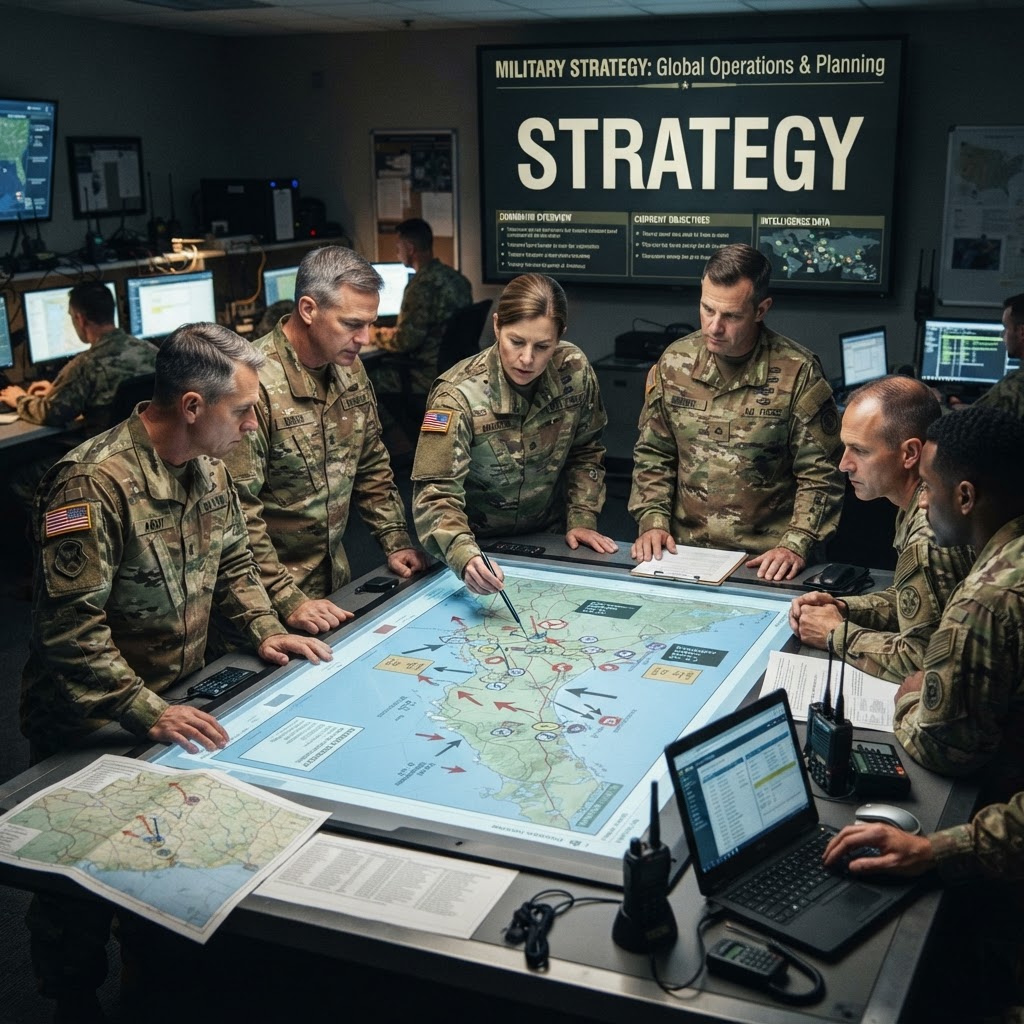
The Strategic Art of War: Understanding Military Strategy Through the Ages
By Pantheon Battles.AI | Military Strategy Series
Introduction: The Difference Between Fighting and Winning
History is filled with commanders who won every battle yet somehow lost the war. It is equally filled with leaders who suffered catastrophic defeats on the battlefield yet ultimately prevailed in the conflict that mattered. This paradox sits at the very heart of what separates the art of military strategy from the mere act of combat.
Strategy is not tactics. It is not logistics. It is not even leadership in the conventional sense. Strategy is the supreme intellectual discipline of war — the capacity to align military force with political purpose across time, space, and human will. To understand it is to begin understanding why wars are really won and lost.
Welcome to The Strategic Art of War, Pantheon Battles.AI's deep exploration of one of humanity's oldest and most consequential intellectual traditions.
What Is Military Strategy? Defining the Discipline
The word strategy derives from the ancient Greek stratēgia — the "art of the general." But defining it precisely has occupied military thinkers for millennia, and their definitions reveal as much about their era as they do about the concept itself.
The Prussian philosopher of war Carl von Clausewitz gave us perhaps the most enduring definition in his seminal work On War (1832):
"Strategy is the use of the engagement for the purpose of the war."
In other words, strategy determines how battles are employed to achieve war's ultimate objectives. It is the connective tissue between the clash of armies in the field and the political outcomes that justify the bloodshed.
The Swiss theorist Antoine-Henri Jomini, Clausewitz's great rival in Napoleonic-era military thought, offered a more geometric interpretation, emphasizing the importance of lines of operation, key terrain, and the concentration of forces. Where Clausewitz saw war as a dynamic, politically embedded human activity, Jomini saw it as a calculable science — a tension that still echoes in military academies today.
In the modern era, strategists have refined the definition further. American military doctrine distinguishes between three interlocking levels of war:
| Level | Focus | Example | |---|---|---| | Strategic | Aligning military power to achieve national objectives | Deciding to invade Normandy to defeat Nazi Germany | | Operational | Campaigns and major operations within a theater | Planning the campaign from the beaches to Berlin | | Tactical | Individual battles and engagements | The assault on Omaha Beach on June 6, 1944 |
Each level is distinct yet inseparable. Tactical brilliance without strategic vision is ultimately wasted energy. Strategic genius without tactical execution remains theory. The greatest commanders in history — Caesar, Napoleon, Frederick the Great, Washington — mastered the interplay between all three.
The Pillars of Military Strategy
Before examining grand strategy versus military strategy, it is essential to understand the foundational concepts that underpin all strategic thinking. These are not abstract academic constructs — they are the enduring principles that have shaped campaigns from antiquity to the modern age.
1. Ends, Ways, and Means
The most fundamental framework in strategic thinking is the relationship between ends (the objectives you seek to achieve), ways (the methods and approaches you employ), and means (the resources — troops, ships, treasure, political capital — available to you).
Sound strategy requires alignment across all three. When your ends are larger than your means can support, you face strategic overextension — the condition that has destroyed empires from ancient Rome to Napoleonic France. When your means exceed your stated ends, you may be wasting national power. Strategic wisdom lies in calibrating these three variables with ruthless honesty.
Napoleon's catastrophic Russian campaign of 1812 stands as a textbook study in ends-ways-means misalignment. His ends — forcing Tsar Alexander I to comply with the Continental System — were arguably achievable through limited demonstration of force. But his ways — a total invasion with over 600,000 troops — consumed means that France simply could not sustain across the vast Russian theater of operations, especially against an enemy willing to trade space for time.
2. The Principle of Objective
Every military operation must serve a clearly defined, decisive objective. This seems obvious, yet history is littered with campaigns that drifted without clear purpose — a phenomenon modern strategists call mission creep.
Sun Tzu identified this principle over 2,500 years ago in The Art of War:
"The general who wins the battle makes many calculations in his temple before the battle is fought. The general who loses makes but few calculations beforehand."
The clarity of objective separates campaigns like Operation Overlord — with its well-defined purpose of establishing a decisive western front against Germany — from the muddled Allied intervention in Russia during 1918-1920, where objectives shifted constantly and forces were insufficient to achieve any of them.
3. Mass and Economy of Force
Two seemingly contradictory principles that must be balanced: mass demands the concentration of combat power at the decisive point, while economy of force demands the minimum allocation of resources to secondary efforts. Together, they represent the art of knowing where to hit hard and where to hold light.
Frederick the Great was perhaps the supreme practitioner of this art. Facing adversaries on multiple fronts during the Seven Years' War (1756-1763), he used interior lines to rapidly concentrate his Prussian forces against individual enemies before they could combine against him — a strategy of successive concentration that punched far above Prussia's weight in European power politics.
4. Offensive Action and Initiative
The strategist who dictates the tempo and terms of a conflict holds a profound psychological and operational advantage. Seizing and maintaining the initiative forces the enemy into a reactive posture, disrupting their planning cycles and compounding their confusion.
Erwin Rommel's conduct of mobile armored warfare in North Africa demonstrated this principle at the operational level. By attacking before defenders could consolidate, he repeatedly forced numerically superior British forces into retreat — though it must be noted that his operational genius ultimately ran aground on strategic and logistical realities beyond his control.
5. The Center of Gravity
Borrowing from Newtonian physics, Clausewitz introduced the concept of the Schwerpunkt — the center of gravity — as "the hub of all power and movement, on which everything depends." Strike the enemy's center of gravity decisively, and resistance collapses. Miss it, and your blows land in the wrong place.
Identifying the true center of gravity is one of strategy's most demanding intellectual tasks, because it is rarely simply the enemy's army. It may be his capital, his alliance system, his economic base, his will to fight, or the population's support for the conflict.
Union strategy in the American Civil War evolved as Northern commanders gradually identified the Confederacy's center of gravity. Early Union commanders focused narrowly on capturing Richmond. It was only when Ulysses S. Grant and William T. Sherman adopted a comprehensive strategy attacking Confederate armies, infrastructure, and civilian will simultaneously that the Confederacy's center of gravity was successfully addressed.
Grand Strategy vs. Military Strategy: The Critical Distinction
This is perhaps the most important conceptual distinction in the entire discipline of strategic studies — and the most frequently confused, even by those in power.
Grand Strategy: War in Its Fullest Dimension
Grand strategy — sometimes called national strategy or high strategy — operates at the highest level of political and military leadership. It encompasses the totality of a nation's power, coordinating all instruments of national power toward the achievement of fundamental political objectives.
The instruments of grand strategy are commonly captured in the acronym DIME:
- Diplomatic — alliances, negotiations, international pressure
- Informational — propaganda, psychological operations, narrative control
- Military — armed force and coercion
- Economic — trade, sanctions, financial warfare, resource control
Grand strategy asks the most fundamental questions: What are we ultimately trying to achieve? Why are we fighting? What kind of peace do we want at war's end? It sits at the intersection of politics, economics, diplomacy, and military power.
The British strategist B.H. Liddell Hart — one of the 20th century's most influential strategic thinkers — captured this perfectly:
"Grand strategy should both calculate and develop the economic resources and man-power of nations in order to sustain the fighting services. Also, the moral resources — for to foster the people's willing spirit is often as important as to possess the more concrete forms of power."
Military strategy, by contrast, is a subordinate instrument of grand strategy — the theory and practice of using armed force specifically to achieve the political objectives grand strategy defines.
Military Strategy: The Art of Armed Force
Military strategy concerns itself with how military power — armies, navies, air forces, and in the modern era, cyber and space capabilities — is organized, deployed, and employed to achieve the objectives set by grand strategy. It bridges the policy level and the operational level, translating political intent into military campaigns.
Military strategy asks: How do we use our armed forces to compel, deter, or defeat the enemy? Where do we fight, when do we fight, and how do we achieve decision?
The relationship between grand strategy and military strategy is not always harmonious — indeed, some of history's greatest disasters have resulted from their misalignment.
Historical Case Studies: Grand Strategy vs. Military Strategy in Action
The distinction becomes most vivid — and most instructive — when examined through specific historical cases.
Case Study 1: Athens and Sparta — The Peloponnesian War (431–404 BC)
The conflict between Athens and Sparta represents one of history's earliest and most instructive contrasts between grand strategy and military strategy.
Athenian Grand Strategy under Pericles was a masterpiece of conceptual clarity. Athens was fundamentally a maritime power, financially dependent on its empire and its control of Aegean trade routes. Sparta was a land power whose hoplite phalanx was effectively invincible in pitched battle. Pericles therefore developed a grand strategy that:
- Refused decisive land battle with Sparta, denying the enemy its greatest advantage
- Leveraged Athenian naval supremacy to maintain trade and project power
- Protected the city's population behind the Long Walls connecting Athens to its port of Piraeus
- Relied on financial endurance to outlast Spartan willingness to sustain the conflict
His military strategy was the direct expression of this grand strategic logic: avoid land engagements, conduct naval raids on the Peloponnesian coast, maintain the alliance network, and wait for Sparta to accept terms.
The military logic was arguably sound. But Athens fatally undermined its own grand strategy through political failures Pericles could not control: a devastating plague that killed Pericles himself, the catastrophic Sicilian Expedition of 415-413 BC — a massive strategic overextension that destroyed the Athenian fleet — and the collapse of internal political cohesion.
The lesson is profound: a superior military strategy cannot rescue a failed grand strategy. Athens repeatedly demonstrated military capability, yet strategic incoherence — driven by political factionalism and imperial overreach — doomed the enterprise.
Case Study 2: Hannibal Barca and the Limits of Military Brilliance (218–202 BC)
Few commanders in history have demonstrated more dazzling military strategic genius than Hannibal Barca. His Alpine crossing, his systematic destruction of Roman armies at Trebia (218 BC), Lake Trasimene (217 BC), and most spectacularly Cannae (216 BC) — where roughly 50,000 Romans were annihilated through history's most perfect encirclement — represent the pinnacle of battlefield operational art.
Yet Hannibal never took Rome. He was in Italy for sixteen years and ultimately left, undefeated in the field, to face defeat at Zama in 202 BC.
Why?
Because Hannibal's military strategy, brilliant as it was, was not matched by a Carthaginian grand strategy capable of supporting it.
His grand strategic theory — that shattering Roman armies would cause Rome's Italian allies to defect, collapsing the Roman confederation — proved partially correct after Cannae, when several Italian cities did switch allegiance. But it fundamentally underestimated Roman strategic resilience. Rome refused to engage in the decisive battle Hannibal needed after Cannae, adopting the Fabian strategy of harassment and attrition. The Roman Senate refused to negotiate even in the darkest hours.
Meanwhile, Carthage's grand strategy failed to provide Hannibal with the siege equipment and reinforcements he needed to strike the decisive blow. Competing interests — including the war in Spain and factional politics in Carthage — meant the man who needed 50,000 more soldiers received almost none.
Hannibal's tragedy is the tragedy of military genius trapped within grand strategic failure. He demonstrated that winning battles, even brilliant ones, cannot substitute for strategic coherence at the highest level.
Case Study 3: Napoleon Bonaparte — Grand Strategy at its Zenith and Nadir
Napoleon Bonaparte represents perhaps history's most extraordinary — and ultimately most instructive — study in the relationship between military and grand strategy.
Napoleon's Military Strategy was revolutionary. He transformed the Napoleonic corps system into a weapon of unprecedented flexibility, capable of marching dispersed to forage independently and concentrating with stunning speed against a single enemy before it could concentrate against him. His strategy of the central position — placing his forces between divided enemy armies and defeating each in turn — produced masterpieces like Ulm (1805) and the Jena-Auerstedt campaign of 1806, where Prussia was destroyed in a single campaign.
His grand strategy, at least during the Consulate and early Empire, was equally impressive. The Peace of Amiens (1802), the reorganization of French satellite states, and the neutralization of Austria through diplomacy and force reflected a sophisticated understanding that sustained power required not merely battlefield victory but political consolidation.
But Napoleon's grand strategic vision became increasingly divorced from reality as his ambitions expanded. The Continental System — his grand strategic attempt to strangle Britain economically by closing European ports to British trade — was strategically coherent in theory but impossible to enforce without the naval power France lacked. Enforcing it required dominating every European coastline, which in turn required fighting endless wars to maintain compliance.
This is the grand strategic trap: a strategy that creates the necessity for endless war to sustain itself is a strategy that will eventually consume its creator.
The Peninsular War (1808-1814) revealed Napoleon's grand strategic overreach most clearly. Invading Spain to enforce the Continental System created a new front that consumed 300,000 French troops in endless guerrilla warfare — what Napoleon himself called his "Spanish ulcer." The Russian campaign of 1812 delivered the fatal blow: a massive military operation driven by grand strategic necessity (Russia's defection from the Continental System) that exceeded France's means, destroyed the Grande Armée, and ultimately ended the Napoleonic Empire.
The lesson: Grand strategy must be grounded in sober assessment of durable power, not the momentum of previous victories.
Case Study 4: The American Civil War — The Evolution of Union Grand Strategy
The American Civil War offers a textbook study in the gradual development of a coherent grand strategy from initially muddled strategic concepts.
Early Union Strategy: Scott's Anaconda Plan — proposed by General-in-Chief Winfield Scott in 1861 — was actually a sophisticated piece of grand strategic thinking. Scott proposed:
- A naval blockade of Confederate ports to strangle Southern commerce
- A major offensive down the Mississippi River to split the Confederacy
- Avoiding costly direct assaults in favor of economic exhaustion
The plan was derided in the press as too slow and passive — the Northern public demanded swift military victory. But history has largely vindicated Scott's strategic instincts. The war essentially unfolded along his proposed lines, just more violently and bloodily than he imagined.
Lincoln as Grand Strategist: Abraham Lincoln demonstrated extraordinary grand strategic intuition despite having no formal military education. He understood several key truths:
- The political objective — restoration of the Union — required not merely military victory but the political legitimacy to actually reconstruct the country afterward
- The center of gravity was not Confederate territory but Confederate armies and Confederate will to resist
- International diplomacy was a critical grand strategic front — keeping Britain and France from recognizing the Confederacy was as important as winning battles
The Emancipation Proclamation of 1863 was primarily a grand strategic masterstroke. By reframing the war as a conflict over slavery, Lincoln made British recognition of the Confederacy politically impossible — British public opinion overwhelmingly opposed slavery, and no British government could enter the war on the Confederate side after emancipation. A single political act transformed the international grand strategic landscape.
Grant's Military Strategy — finally appointed as general-in-chief in March 1864 — expressed the Union's grand strategic logic with brutal clarity: attack Confederate armies simultaneously on all fronts, giving them no time to shift forces, no space to rest, and no opportunity for respite. His famous instruction to Sherman captured the military strategic intent perfectly:
"Get into the interior of the enemy's country as far as you can, inflicting all the damage you can against their war resources."
Sherman's March to the Sea was not merely a military operation — it was a grand strategic act, designed to break Confederate civilian will, destroy the economic resources sustaining Confederate armies, and demonstrate that the Confederate government could not protect its own population.
The Civil War's strategic lesson: Grand strategy requires the coordination of political, diplomatic, and military instruments. Lincoln's management of all these simultaneously, despite enormous political pressures, represents one of history's finest examples of grand strategic leadership.
Case Study 5: World War II — Competing Grand Strategies
The Second World War offers the richest possible environment for studying grand strategy and military strategy, with multiple major powers pursuing fundamentally different strategic concepts simultaneously.
Germany's Grand Strategic Failure
Germany's military strategy in 1940 was extraordinary. The Fall of France remains one of the most astonishing campaigns in military history — six weeks to destroy an opponent that had held Germany at bay for four years in the First World War. The Manstein Plan (attacking through the Ardennes to cut off Allied forces in Belgium) was a masterpiece of operational military strategy.
But German grand strategy was incoherent from the beginning. Hitler's ideology-driven decision-making — declaring war on the United States after Pearl Harbor when no strategic logic demanded it, pursuing racial annihilation in the East at the cost of massive military-economic inefficiency, refusing to mobilize the German economy to war footing until 1942-43 — repeatedly sacrificed grand strategic rationality for ideological conviction.
The decision to invade the Soviet Union in 1941 while Britain remained undefeated in the West created the two-front war that Germany's grand strategy was supposed to prevent. Operation Barbarossa achieved extraordinary military results in its opening months — yet the grand strategic objective, knocking the USSR out of the war before American entry could tip the balance, was never achieved.
British Grand Strategy: The Churchill Synthesis
Winston Churchill was a grand strategist of the first order, though his operational instincts were sometimes less reliable. His grand strategic priorities were clear:
- Survival first — ensure Britain could not be conquered or starved into submission
- Bring in the Americans — make Anglo-American coalition the foundation of eventual victory
- Fight on the periphery — attack the Axis in North Africa and the Mediterranean to build strength before direct confrontation in France
His management of the Anglo-American alliance was a sustained grand strategic achievement. Maintaining American commitment to the "Europe First" strategy despite Pearl Harbor demanding action in the Pacific, while simultaneously managing British imperial interests and the relationship with Stalin, required constant, sophisticated grand strategic management.
The Allied Grand Strategy: OVERLORD and Beyond
The Allied grand strategy for defeating Germany combined:
- Strategic bombing to destroy German industrial capacity (economic warfare)
- Atlantic naval campaign to secure supply lines (logistical warfare)
- Mediterranean campaigns to drain German reserves and knock out Italy (political/military warfare)
- Eastern Front — allowing the Soviet Union to absorb the majority of German ground forces
- OVERLORD — the decisive campaign to destroy German military power in the West
Each element was an instrument of grand strategy, coordinated to achieve the ultimate political objective: unconditional German surrender.
The military strategy for OVERLORD itself — landing in Normandy rather than the Pas-de-Calais, using Operation Bodyguard to deceive German defenders, building artificial harbors (Mulberry) to sustain logistical support, breaking out through Saint-Lô — reflected meticulous integration of military strategic planning with grand strategic purpose.
The Enduring Principles: What History Teaches
Across these diverse case studies — separated by centuries and vastly different circumstances — certain enduring strategic lessons emerge with striking consistency:
1. Political Objectives Must Always Drive Military Strategy
Clausewitz's most fundamental insight remains undiminished: "War is a continuation of politics by other means." Military strategy divorced from clear political purpose becomes an exercise in purposeless violence. Before the first soldier marches, the strategist must ask: What political outcome are we trying to achieve, and how does military force serve that outcome?
2. Know Your Enemy's True Center of Gravity
Endless effort applied to the wrong objective is strategically worthless. The most important — and most difficult — task in strategy is correctly identifying what will actually cause the enemy to stop fighting. Sometimes it is his army. Sometimes it is his economic base. Sometimes it is his political will. Often it is a combination. The strategist who gets this wrong will win battles and lose wars.
3. Grand Strategy Must Be Sustainable
History's great strategic disasters share a common thread: they exhausted national power faster than they achieved decisive results. Hannibal needed more from Carthage than Carthage could give. Napoleon's Continental System required more than France could control. Germany's two-front war consumed more than German industry and manpower could sustain. Durable grand strategy operates within the boundaries of sustainable national power.
4. Military Genius Cannot Compensate for Grand Strategic Incoherence
This is perhaps the hardest lesson for military professionals to accept, because it implies that tactical and operational brilliance can be ultimately irrelevant. Hannibal won every major battle against Rome and lost the war. The German military machine produced operational masterpieces in France, North Africa, and the opening phases of Barbarossa, and still lost the war. Battlefield genius is a multiplier of strategic power — but it cannot substitute for it.
5. All Instruments of Power Must Be Coordinated
The most successful grand strategies in history — Rome's, Britain's management of the Napoleonic Wars, the Allied strategy in World War II — succeeded because they coordinated military, diplomatic, economic, and informational power toward a common objective. The failure to mobilize all available instruments of power — whether from factional politics, institutional stovepipes, or simple strategic myopia — is a recurring source of strategic failure.
6. The Enemy Has a Vote
Strategy is not a plan executed against an inanimate object. The enemy adapts, innovates, and exploits weakness. Sun Tzu's most enduring contribution may be his insistence on knowing the enemy as thoroughly as you know yourself — because the most elegant strategic concept can be undone by an adversary who successfully identifies and attacks its assumptions. Rome's refusal to accept defeat after Cannae defeated Hannibal's grand strategic theory. The German failure to understand Soviet strategic depth and resilience doomed Operation Barbarossa.
Sun Tzu and Clausewitz: The Twin Pillars of Strategic Thought
No discussion of the art of war would be complete without acknowledging the two foundational texts that have shaped strategic thinking more than any others.
Sun Tzu's The Art of War (c. 500 BC) emphasizes deception, intelligence, flexibility, and the avoidance of costly direct confrontation. Its most celebrated principle — "Supreme excellence consists in breaking the enemy's resistance without fighting" — points toward a strategy of maneuver, psychological disruption, and the exploitation of the enemy's weaknesses rather than tests of strength. Sun Tzu's strategic philosophy is inherently asymmetric: if you must fight, something has already gone wrong.
Clausewitz's On War (1832) represents the Western tradition at its most rigorous. His emphasis on the primacy of politics, the concept of friction (the accumulated uncertainties and failures that make war far harder to execute than plans suggest), the fog of war, and the dynamic nature of military confrontation produced a framework that remains central to Western military education. Clausewitz does not romanticize strategy — he presents it as a brutal, uncertain, politically embedded activity in which plans routinely fail and only those with the moral courage and intellectual flexibility to adapt survive.
Together, these two traditions — the Eastern emphasis on indirection, intelligence, and avoidance of decisive confrontation, and the Western emphasis on political purpose, decisive engagement, and the management of uncertainty — offer complementary lenses through which to understand the full spectrum of strategic art.
The Strategic Art in the Modern Era
The fundamental principles of strategy have not changed — but the instruments and environment of strategy have transformed dramatically.
Nuclear deterrence introduced an entirely new dimension of grand strategy, in which the threat of force became more strategically significant than its use. The logic of Mutually Assured Destruction turned Clausewitz's framework on its head: a war fought with strategic nuclear weapons would have no rational political objective, because the destruction would eliminate the political entity whose interests the war was meant to serve.
Cyber warfare has created new domains of grand strategic competition, allowing states to attack economic infrastructure, steal intelligence, disrupt political systems, and project coercive power without a single shot being fired.
Counterinsurgency and hybrid warfare have resurrected Sun Tzu's emphasis on political legitimacy, population support, and the fundamental limitations of military force in achieving political objectives — lessons that the United States absorbed at great cost in Vietnam, Iraq, and Afghanistan.
Yet even in this transformed landscape, the enduring principles apply. Grand strategy must still coordinate all instruments of power toward clear political objectives. Military strategy must still serve those objectives. Ends, ways, and means must still be balanced. And the enemy still has a vote.
Conclusion: Strategy as the Highest Art
The strategic art of war is ultimately the art of connecting violence to purpose — of ensuring that the terrible energies of armed conflict serve the political objectives that justify their unleashing. When that connection is clear, sustained, and coherent across all levels from the grand strategic to the tactical, military power achieves results disproportionate to the forces applied. When that connection breaks down — when military strategy diverges from grand strategy, when political objectives become confused, when means are insufficient to ends — even the greatest armies and the most brilliant commanders ultimately fail.
The history of warfare is, at its deepest level, a history of strategic success and strategic failure. Understanding why the Roman Republic survived Cannae while Carthage did not. Understanding why Napoleon's Grande Armée dissolved in the Russian snows. Understanding why Lincoln's political genius was as essential to Union victory as Grant's military tenacity. This is the education that Pantheon Battles.AI is dedicated to providing.
Because strategy is not merely history. It is the enduring grammar of power — and those who understand it, read the world differently.
"In strategy, it is important to see distant things as if they were close, and to take a distanced view of close things." — Miyamoto Musashi, The Book of Five Rings
© Pantheon Battles.AI | Military History & Strategy Analysis Explore more in our Battle Analysis Series, Grand Strategy Deep Dives, and Commander Profiles.