Operational Art of War
Full Content FreeAugust 23, 2026
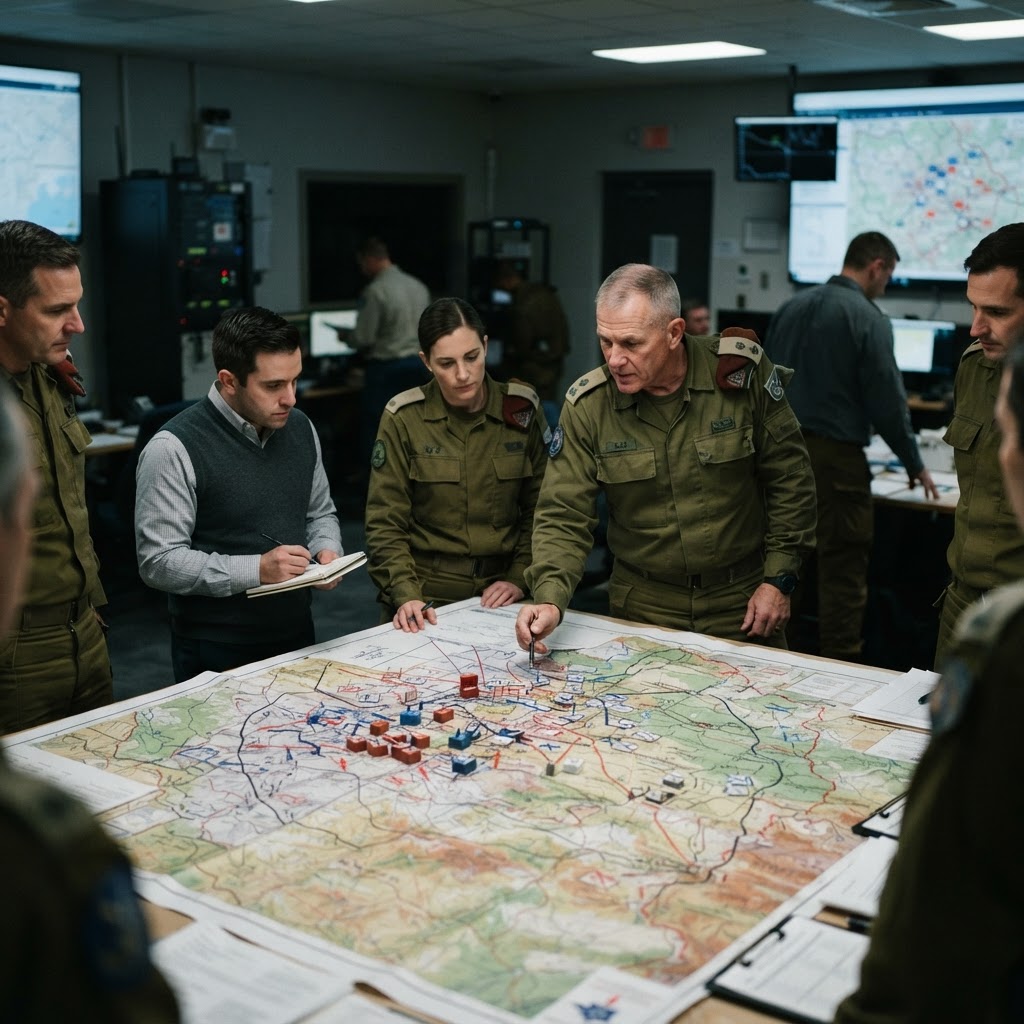
The Three Levels of War: Understanding the Operational Level and Its Place Between Strategy and Tactics
A Framework That Defines How Armies Think, Plan, and Fight
In the vast intellectual architecture of military theory, few conceptual frameworks have proven as enduring — or as practically vital — as the three levels of war: Strategy, Operations, and Tactics. Together, they form a layered hierarchy through which military force is conceived, organized, and ultimately applied. Each level has its own logic, its own cast of characters, its own timelines, and its own measures of success. Understanding how these levels interact — and particularly how the Operational Level bridges the vast conceptual gulf between grand strategy and the brutal immediacy of the battlefield — is essential to understanding why armies win or lose wars that their soldiers individually fought so bravely.
At Pantheon Battles.AI, we believe that truly understanding history's greatest battles requires more than cataloguing troop movements and casualty figures. It demands a structural understanding of how commanders think at different altitudes of decision-making. The three levels of war provide exactly that analytical lens.
Strategy: The Realm of Political Purpose
"War is the continuation of politics by other means." — Carl von Clausewitz, On War, 1832
Strategy is the highest level of war — and paradoxically, the level most distant from actual fighting. At its core, strategy is the art and science of connecting military power to political objectives. It answers the most fundamental question a nation can ask: What are we fighting for, and how do we use all available instruments of power to achieve it?
Strategic decisions are made by the highest levels of government and military leadership — heads of state, national security councils, chiefs of defense, and senior cabinet officials. The instruments of strategy extend well beyond armies and navies. Economists, diplomats, intelligence agencies, and propagandists are all players in the strategic game. The modern acronym DIME — Diplomatic, Informational, Military, and Economic power — captures this breadth.
Strategic thinking operates across long time horizons, often spanning years or even decades. It concerns itself with questions such as:
- What political end state do we seek to achieve through this conflict?
- How should national resources be allocated across competing theaters and priorities?
- Which alliances must be built, maintained, or broken?
- What are the acceptable costs — in blood, treasure, and political capital — of this war?
- How does military action connect to the desired post-war order?
Examples of strategic decisions include President Roosevelt and Prime Minister Churchill's "Europe First" policy in World War II — a choice to prioritize the defeat of Nazi Germany over Imperial Japan despite the emotional pull of Pearl Harbor. Or consider Napoleon's grand strategic vision of breaking the Continental System's opponents through rapid, decisive campaigns before coalition partners could coordinate. These were not battlefield decisions. They were choices about which wars to fight, when, and with what resources.
The critical characteristic of strategy is that success is measured in political outcomes, not military ones. A nation can win every battle and still lose the war — as the United States arguably discovered in Vietnam — if the military effort fails to translate into a sustainable political resolution. Strategy is where war and statecraft are inseparable.
Tactics: The Realm of Contact and Killing
At the opposite end of the spectrum sits Tactics — the level of war most familiar to the popular imagination, and the level most viscerally connected to the human experience of combat.
Tactics is the science and art of employing military forces in direct contact with the enemy to achieve immediate, localized objectives. Where strategy asks why we fight and what we seek, tactics asks the urgent, dangerous question: How do we defeat this enemy in front of us, right now?
Tactical decisions are made by junior and mid-grade officers and NCOs — squad leaders, platoon commanders, company commanders, battalion commanders, and sometimes brigade commanders depending on context. The time horizons at the tactical level are measured in hours, minutes, or even seconds. The geography is intimate — a treeline, a ridge, a village, a beach.
Tactical thinking is concerned with:
- How do we maneuver our forces to gain a positional advantage?
- How do we synchronize fires (artillery, air support, direct fire) with movement?
- How do we exploit a gap in the enemy's line?
- How do we defend a position with limited resources against superior numbers?
- How do we maintain unit cohesion under fire?
The language of tactics is rich with concepts like fire and movement, envelopment, penetration, defense in depth, ambush, exploitation, and consolidation. The great tactical innovations of history — Frederick the Great's oblique attack, Wellington's reverse slope defense, the German Stormtrooper infiltration tactics of 1917-1918 — were responses to specific battlefield challenges, solutions to the immediate problem of how to break an enemy's physical and moral resistance.
Success at the tactical level is measured in concrete, local terms: Did we take the objective? Did we hold the line? Did we destroy that battalion? Did we cross the river? Tactical victories accumulate — or fail to accumulate — into something larger. And this is precisely where the critical middle tier enters the picture.
The Operational Level: The Art of Connecting Ends to Means
The Operational Level of War is the intellectual heart of modern military practice — and historically, the most underappreciated and least understood of the three tiers. It occupies the crucial conceptual space between the grand designs of strategy and the bloody realities of tactical combat.
The operational level is where campaigns are designed and conducted. It is the level at which military commanders answer the question that neither strategists nor tacticians can fully address on their own: How do we sequence, synchronize, and sustain a series of tactical actions to achieve the strategic objective?
Operational decisions are made by senior military commanders — army commanders, theater commanders, corps commanders, fleet admirals, and their staffs. The time horizons are weeks to months, and the geographic scale spans entire theaters of war — not a single ridge or city block, but potentially hundreds or thousands of square miles.
What Makes the Operational Level Distinct?
The operational level emerged as a formal conceptual category relatively recently in the Western military tradition. The Soviet military theorists of the 1920s and 1930s — particularly Marshal Mikhail Tukhachevsky and his colleagues — were among the first to codify it explicitly, developing the theory of Deep Battle (Глубокая операция / Glubokaya Operatsiya). They recognized that the industrial-age battlefield had grown too vast and too complex for tactics alone to deliver strategic results. You needed a linking layer — a framework for transforming scattered tactical victories into theater-wide paralysis of the enemy.
The U.S. military formally adopted the operational level as a recognized tier in its doctrinal publications in the early 1980s, enshrining it in the landmark AirLand Battle doctrine and the 1982 edition of FM 100-5: Operations. This was, in part, a direct intellectual response to studying Soviet operational doctrine and to the lessons of post-Vietnam military reform.
At its core, the operational level is concerned with several defining concepts:
📌 The Campaign
The operational level thinks in campaigns, not battles. A campaign is a series of related military operations aimed at accomplishing a strategic or operational objective within a given time and space. The Normandy Campaign of 1944, Operation MARKET GARDEN, the Guadalcanal Campaign, Operation BAGRATION — these are operational-level constructs. Individual battles within them — the assault on Omaha Beach, the defense of the Nijmegen bridge — are tactical events. The design and management of these events as part of a coherent whole is operational art.
📌 Operational Art
Operational Art is perhaps the most elegant concept at this level — the creative, cognitive dimension of planning campaigns. It is the skill of translating strategic aims into achievable operational objectives, and then sequencing tactical actions to accomplish them efficiently. Operational art requires commanders and their staffs to think spatially (where to mass, where to feint, where to strike deep), temporally (when to attack, when to pause, when to exploit), and logistically (what the force can actually sustain given its supply lines).
The great masters of operational art — Napoleon, Grant, Manstein, Zhukov, Slim — shared an ability to hold the macro and micro simultaneously: understanding the big picture while remaining sensitive to the cascading effects of tactical developments on their broader designs.
📌 Centers of Gravity and Critical Vulnerabilities
At the operational level, commanders think carefully about centers of gravity (COGs) — those sources of power that give the enemy the will or ability to fight. Destroy or neutralize the enemy's operational center of gravity, and the entire structure of his resistance may collapse, regardless of the outcome of individual engagements. This concept, rooted in Clausewitz but developed extensively in modern doctrine, is quintessentially operational in its application.
📌 Lines of Operation and Effort
Operational planners think in terms of lines of operation — the directional axes along which forces attack — and lines of effort — the coordinated activities (military, informational, diplomatic) that converge on the operational objective. Managing these lines, preventing them from operating at cross-purposes, and reinforcing success along the most promising axis is a central operational challenge.
📌 Deep, Close, and Rear Operations
Modern operational doctrine divides the battlefield into close operations (the current fight), deep operations (actions against the enemy's follow-on forces, reserves, and command structure before they can influence the close battle), and rear operations (protecting one's own sustainment and command infrastructure). The ability to simultaneously conduct all three is the hallmark of mature operational capability. The German Blitzkrieg campaigns of 1939-1941 were revolutionary precisely because they collapsed the enemy's ability to distinguish between close and deep — armor and mechanized infantry drove so far, so fast, that operational depth became meaningless.
📌 Culmination and Operational Pauses
A uniquely operational concern is the concept of culmination — the point at which an attacking force has spent so much of its combat power and logistical capacity that it can no longer maintain the offensive. Recognizing when a force is approaching culmination — and either exploiting momentum before that point or pausing to reconstitute — is a critical operational judgment. Napoleon's catastrophic 1812 Russian campaign is partly a story of strategic miscalculation and partly one of failure to recognize operational culmination as his army drove deeper and deeper toward Moscow, each tactical victory draining resources that could never be replaced.
The Interface Between the Levels: Where Wars Are Won or Lost
The true genius of understanding these three levels lies not merely in grasping each in isolation, but in understanding how they interact — and how failures of translation between levels have destroyed armies throughout history.
The Strategy-Operations Interface
The most common failure here is strategic impatience with operational realities. Political leaders demand results on timelines that operational commanders know are logistically impossible. Hitler's interference in the operational conduct of Operation Barbarossa and the 1942 Summer Offensive — repeatedly diverting operational priorities based on political and personal whims — is perhaps history's most catastrophic example of strategic-operational disconnection.
Conversely, operational commanders sometimes pursue operational logic at the expense of strategic wisdom. A brilliant operational victory that triggers political consequences the strategy never accounted for can be worse than no victory at all. Israel's deep operational success in the 1982 Lebanon War, for instance, produced strategic complications that outweighed the tactical and operational gains.
The Operations-Tactics Interface
Here the failure often runs in the opposite direction: tactical results that don't serve operational purposes. Units fight hard for objectives that an operationally-minded commander would never have prioritized. Or conversely, operational plans are drawn up with insufficient sensitivity to what is tactically feasible — assuming maneuver rates, attrition levels, or logistics that real soldiers and real terrain simply cannot deliver.
The Allied experience at Arnhem in September 1944 — Operation MARKET GARDEN — illustrates this precisely. The operational concept (a bold airborne thrust to bridge the Rhine and outflank German defenses) was daring and potentially war-shortening. But the tactical realities (too few drop zones, poor radio communications, an underestimated German armored presence, a single-axis ground relief corridor) made the operational ambition unreachable. The gap between operational concept and tactical execution proved fatal to the paratroopers at Arnhem.
A Comparative Summary
| Dimension | Strategy | Operations | Tactics | |---|---|---|---| | Core Question | Why fight, and what outcome do we seek? | How do we sequence actions to achieve strategic aims? | How do we defeat the enemy in front of us? | | Decision Makers | Heads of state, senior military leadership, national security apparatus | Theater/Army commanders and their planning staffs | Battalion, company, platoon, squad leaders | | Time Horizon | Years to decades | Weeks to months | Hours to days | | Geographic Scale | Global or theater-wide | Theater to regional | Local (battlefield, city, sector) | | Key Concepts | National interest, alliance management, DIME, ends-ways-means | Campaigns, operational art, COGs, deep/close/rear operations | Fire and movement, envelopment, exploitation, defense | | Measure of Success | Desired political end state achieved | Strategic objectives enabled through campaign success | Objectives seized, enemy forces destroyed or displaced | | Famous Examples | "Europe First" strategy, WWII | Operation BAGRATION, 1944 | The assault on Omaha Beach, D-Day |
Why the Operational Level Matters Most to Military Historians
For students of military history — and for the Pantheon Battles.AI community in particular — the operational level is arguably the richest analytical layer through which to examine historical campaigns. It is the level at which:
- Commanders make decisions with incomplete information but real consequences
- Logistics and geography assert themselves as genuine determinants of outcome
- The human factor — the cognitive skill of generals, the quality of their staffs — is most directly decisive
- The gap between plan and reality is most dramatically revealed
- Great campaigns of maneuver and strategic paralysis — the campaigns that define military legacies — are conceived and executed
When we study why Grant succeeded in the Overland Campaign, why Rommel's operational instincts in North Africa outpaced his strategic and logistical resources, why Zhukov's operational design at Kursk and beyond shattered the Wehrmacht's offensive capability forever — we are working at the operational level. It is where the historian's craft and the strategist's mind meet most productively.
Conclusion: A Framework for All Time
The three levels of war — Strategy, Operations, and Tactics — are not merely bureaucratic categories or academic abstractions. They represent fundamentally different modes of thinking about violence and purpose in conflict. Strategy gives war its meaning. Tactics gives war its texture. But it is the Operational Level that gives war its architecture — the structural framework through which political ambition becomes battlefield reality, or fails to.
The greatest commanders in history have been those who could think fluently across all three levels simultaneously — who understood the political purpose behind their campaigns, designed those campaigns with creative operational genius, and remained sensitive enough to tactical realities to avoid building masterplans on impossible foundations.
Understanding this framework doesn't just help us analyze the battles of the past. It helps us recognize, in real time, the difference between a strategically purposeful use of force and a series of disconnected tactical engagements that consume lives without delivering lasting result. In a world where conflict remains a persistent feature of human affairs, that understanding is more than academic. It is essential.
Explore more campaign analyses, operational deep-dives, and strategic assessments at Pantheon Battles.AI — where history's greatest military minds are studied, debated, and brought to life.