Military Tactics
Full Content FreeAugust 23, 2026
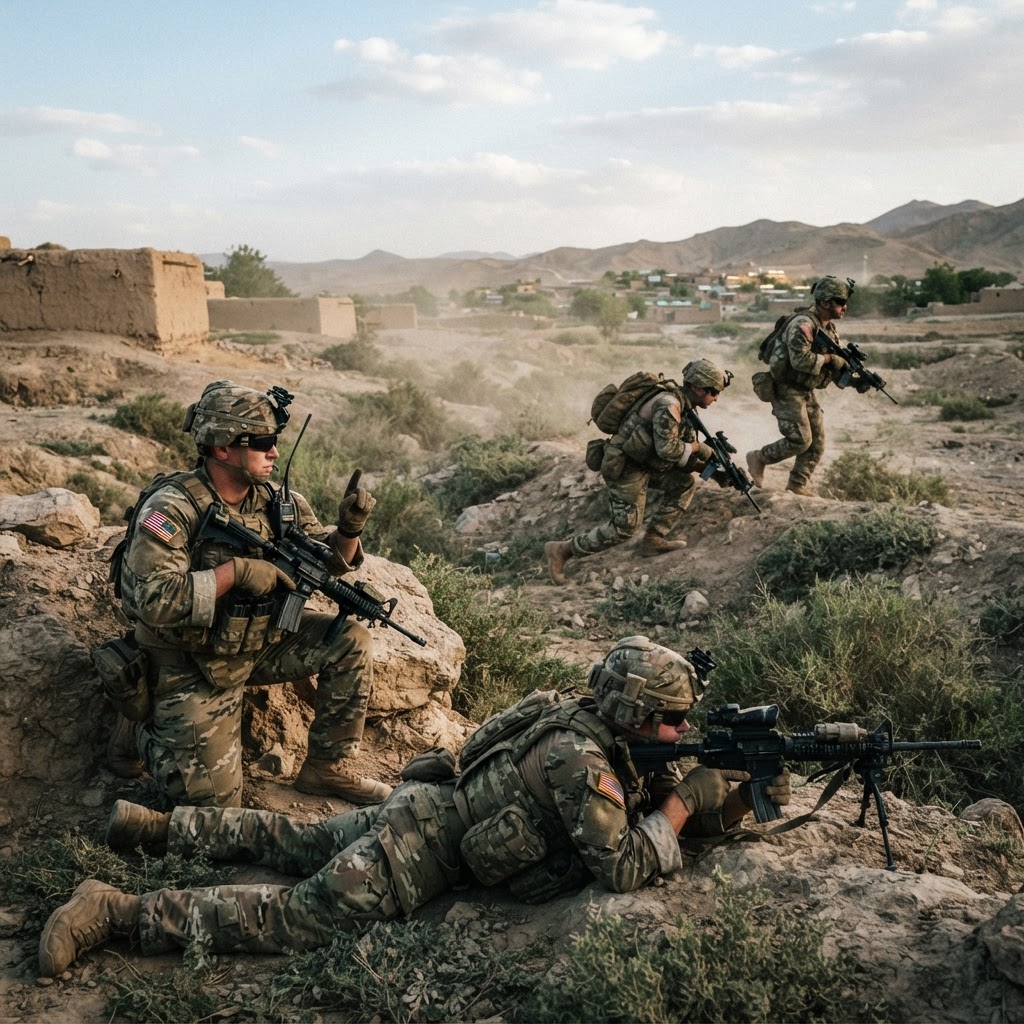
The Three Levels of War: Tactics, Operations, and Strategy
Understanding the Hierarchy That Shapes Military Excellence
Pantheon Battles.AI | Military Doctrine & Analysis
Throughout the long and often brutal history of armed conflict, military thinkers — from Sun Tzu to Clausewitz, from Napoleon to Eisenhower — have grappled with a fundamental challenge: how do you organize the chaos of war into coherent, purposeful action? The answer, refined over centuries of battlefield experience and scholarly reflection, lies in understanding that war does not operate on a single plane. Instead, it unfolds across three distinct but deeply interconnected levels: Tactics, Operations, and Strategy.
These three levels are not merely academic categories. They represent the living architecture of how armies think, plan, move, and fight. Misunderstanding the distinction between them — or worse, confusing one for another — has been the undoing of countless commanders and campaigns throughout history. Understanding them is essential for anyone serious about military history, doctrine, and the art of war.
Military Tactics: The Sharp Edge of Battle
"Tactics is the art of using troops in battle; strategy is the art of using battles to win the war." — Carl von Clausewitz
What Are Tactics?
Military tactics represent the most immediate and visceral level of warfare. They encompass the specific techniques, movements, formations, and decisions made by commanders and soldiers in direct contact with — or in close proximity to — the enemy. Tactics are fundamentally concerned with winning the engagement in front of you, right now, on this ground, with these troops.
Tactically, the questions being asked are sharply focused:
- How do we assault that fortified position?
- How do we defend this ridgeline against a flanking attack?
- How do we coordinate fire and movement across this open ground?
- How do we exploit this gap that has appeared in the enemy's line?
The timescale of tactics is measured in minutes, hours, and days. The geographic scope is confined to the battlefield itself — a hilltop, a village, a treeline, a riverbank. The actors are individual soldiers, squads, platoons, companies, and battalions, with some extension into regimental or brigade-level action depending on the era and doctrine.
The Building Blocks of Tactical Thinking
Tactics are the domain of fire and maneuver, of suppression and exploitation, of defense in depth and the bold counterattack. Across history, certain fundamental tactical principles have proven remarkably enduring:
- Mass and Concentration of Force — Bringing superior combat power to bear at a decisive point. The Romans demonstrated this with their legionary formations; the Mongols with their coordinated cavalry masses.
- Economy of Force — Allocating minimum essential combat power to secondary efforts to preserve strength for the main effort. A commander who over-invests in holding a quiet flank weakens his decisive strike.
- Surprise — Striking the enemy when, where, or in a manner they do not anticipate. Frederick the Great's oblique order at the Battle of Leuthen (1757) achieved devastating tactical surprise against a numerically superior Austrian force.
- Security — Protecting your own force from surprise, reconnaissance, and unexpected attack. This involves screens, pickets, patrols, and flank guards.
- Offensive Action — The principle that offensive action, even when ultimately seeking defensive goals, is generally decisive. Passive defense rarely wins battles.
- Simplicity — Plans that are too complex fracture under the friction of combat. Simple, clear tactical orders survive first contact with the enemy far better than elaborate schemes.
The Tactical Commander's World
A tactical commander is deeply immersed in immediate physical reality. They must read terrain intuitively, understand the morale and physical condition of their troops, manage ammunition and logistics in real time, and make life-or-death decisions under extreme psychological pressure. The great tactical commanders of history — figures like Alexander the Great at Gaugamela, Wellington at Salamanca, or Erwin Rommel in North Africa — possessed an almost preternatural ability to sense the battlefield's rhythm and impose their will upon it in the moment.
Crucially, tactics are also profoundly shaped by technology and doctrine. The introduction of the longbow changed English tactical doctrine dramatically at Crécy (1346). The rifled musket fundamentally altered infantry tactics in the American Civil War, making the massed Napoleonic assault brutally costly. The development of combined arms — infantry, armor, artillery, and air working in synchronized concert — redefined twentieth-century tactical practice entirely.
The Operational Level: The Bridge Between Battle and Victory
"Battles are won by slaughter and maneuver. The greater the general, the more he contributes in maneuver, the less he demands in slaughter." — Winston Churchill
The Often Misunderstood Middle Level
Of the three levels of war, the operational level is historically the most recent to be formally articulated and, arguably, the most frequently misunderstood. It sits between the tactical and the strategic, serving as the critical connective tissue that transforms individual battlefield victories into meaningful campaign progress.
The operational level asks a fundamentally different set of questions than tactics:
- How do we sequence and link multiple engagements to achieve our campaign objective?
- How do we position, sustain, and maneuver our forces across a theater of operations?
- Which battles must we fight, which can we avoid, and how does each engagement shape the next?
- How do we exploit tactical successes before the enemy can reconstitute and recover?
The timescale of operations is measured in weeks and months. The geographic scope spans theaters of operation — broad regions that may encompass hundreds or thousands of square miles. The relevant commanders operate at the corps, army, and army group level, coordinating multiple divisions and managing enormous logistical enterprises.
The Origins of Operational Art
The formal concept of operational art — the skillful arrangement of tactical actions to achieve strategic ends — emerged most explicitly from Prussian and later German military thought in the nineteenth and early twentieth centuries. Helmuth von Moltke the Elder, arguably one of the greatest operational commanders in history, recognized that modern industrialized warfare required a new level of thinking to bridge the growing gap between strategic policy and tactical battle.
The German Army's concept of Auftragstaktik (mission-command tactics) and the development of Bewegungskrieg (war of movement) in the early twentieth century were fundamentally operational ideas. They sought to create tempo, dislocation, and paralysis across an entire theater rather than simply winning individual engagements. The spectacular German campaigns of 1940 — the fall of France in just six weeks — were masterclasses in operational art, using blitzkrieg not merely as a tactical method but as an operational design that targeted the French command structure and strategic coherence rather than simply destroying French units in detail.
The Soviet military, drawing from the theoretical work of Marshal Mikhail Tukhachevsky and others in the 1930s, formalized the operational level most explicitly in their doctrine of Deep Battle and later Deep Operations. This doctrine recognized that modern armies had to simultaneously attack enemy tactical positions, operational reserves, and strategic depth — striking deep to prevent the enemy from ever stabilizing his defense. The Red Army's Operation Bagration in 1944 stands as one of history's most devastating examples of operational mastery, destroying an entire German Army Group through precisely coordinated multi-front deep operations.
Key Operational Concepts
Several concepts are distinctly operational in character:
- Center of Gravity — The source of an enemy's power and cohesion. At the operational level, this might be a critical logistics hub, a headquarters, a key city, or a reserve force. Identifying and targeting the operational center of gravity can collapse enemy resistance without necessarily defeating every unit in detail.
- Lines of Operation and Lines of Effort — How forces are physically arranged and directed across a theater, and how non-physical efforts (information, civil-military, etc.) support campaign goals.
- Operational Depth — Striking deep into enemy-held territory to disrupt reserves, logistics, and command before they can influence the forward battle. This prevents the enemy from maintaining coherent defense.
- Tempo and Initiative — Maintaining a pace of operations that prevents the enemy from recovering, reorganizing, or adapting. Operational commanders who consistently move faster than their opponents' decision cycles can paralyze entire armies.
- Culminating Point — Every offensive operation reaches a point at which it has exhausted its combat power and logistical sustainability. Recognizing and avoiding culmination — or recognizing when an enemy is approaching his — is a critical operational skill.
- Sequencing of Battles — Perhaps most fundamentally, operational art is the deliberate sequencing of engagements so that each battle creates the conditions for the next. Grant's Overland Campaign of 1864 demonstrated this grimly: each battle — the Wilderness, Spotsylvania, Cold Harbor, Petersburg — was part of a relentless operational design to grind down Lee's ability to sustain the Confederate war effort.
The Operational Commander's Challenge
The operational commander must simultaneously look downward to ensure tactical actions are properly resourced, sequenced, and supported, and upward to ensure that the campaign serves the strategic objectives set by political and senior military leadership. This dual focus is genuinely difficult. History is littered with commanders who were brilliant tacticians but poor operational thinkers — winning battles that did not translate into campaign success — and equally, those whose operational designs collapsed because they did not understand the tactical realities their soldiers faced.
Military Strategy: The Grand Architecture of War
"War is the continuation of politics by other means." — Carl von Clausewitz, On War
What Is Military Strategy?
Military strategy operates at the highest level of the military hierarchy — and in some formulations, connects directly to the level of grand strategy or national strategy, where military power is integrated with economic, diplomatic, and informational instruments of national power. Pure military strategy, however, concerns itself with:
- What military objectives must be achieved to win the war?
- How should military force be organized, structured, and allocated across multiple theaters?
- How do military actions relate to the political aims that justify the war's existence?
- What is the relationship between our military strategy and those of our allies and adversaries?
The timescale of strategy is measured in months, years, and sometimes decades. The geographic scope is global or theater-wide at the highest levels. The relevant actors are heads of state, cabinets, joint chiefs of staff, supreme commanders, and the political-military leadership that directs the overall war effort.
The Inseparability of Strategy and Politics
The most profound insight of Clausewitz — still the most important theorist of war in Western military thought — is that war is an instrument of political policy. This means that military strategy must always be subordinate to, and serve, political objectives. When military strategy becomes decoupled from political reality, catastrophe typically follows.
Germany in World War I offers a stark illustration. The Schlieffen Plan was a masterwork of strategic planning in narrow military terms: knock France out quickly in the West, then pivot to defeat Russia in the East. But it systematically ignored the political consequences of invading Belgium (drawing Britain into the war) and the broader question of whether a rapid military victory was actually achievable against an increasingly industrialized and resilient France. Strategy divorced from political reality produced a war of attrition that Germany could not ultimately survive.
Conversely, the Allied strategy in World War II — formalized through the conferences at Casablanca, Tehran, and Yalta — exemplified strategy properly integrated with political goals. The Germany First decision, the strategic bombing campaigns, the sequencing of North Africa → Sicily → Italy → Normandy, and ultimately the broad-front strategy in Northwest Europe all reflected deliberate choices about how military power would be applied to achieve not just military victory but the political outcomes the Allied nations sought.
Levels of Strategy
Military strategy itself can be usefully subdivided:
Theater Strategy concerns how military force is applied within a specific geographic theater to achieve theater-level objectives — the Pacific Theater strategy of island-hopping, for example, was a theater strategy that used operational and tactical actions to progressively reduce Japanese strategic depth and bring air power within range of the Home Islands.
National Military Strategy concerns the overall design for how a nation's armed forces will be organized, equipped, trained, and employed to support national policy objectives. This includes decisions about force structure, military alliances, deterrence doctrine, and the fundamental apportionment of resources between competing services and theaters.
Grand Strategy extends beyond the purely military and integrates all instruments of national and coalition power. The Allied blockade of Germany in World War I was a grand strategic instrument — it was not a purely military act but a coordinated political, economic, and military effort to erode German national will and capability over time. Similarly, the Marshall Plan after World War II was a grand strategic instrument, using economic power to stabilize Western Europe and prevent the spread of Soviet influence.
The Strategic Commander's Burden
Strategic commanders face challenges of an entirely different character from operational or tactical commanders. Their decisions play out over years, their errors may not become apparent until it is too late to correct them, and their actions must be continuously calibrated against political realities that are themselves constantly shifting.
Abraham Lincoln's management of Union strategy during the Civil War is a magnificent study in strategic leadership. Lincoln had to simultaneously manage the military dimensions of the war — finding, eventually, in Grant and Sherman, commanders who understood how to translate tactical and operational action into strategic success — while managing the political dimensions: maintaining Northern public support, handling the border states, navigating international diplomacy to prevent British intervention, and ultimately framing the war's purpose in moral terms through the Emancipation Proclamation that fundamentally altered the conflict's strategic character.
Churchill's wartime strategic leadership offers another model: brilliant in some respects, flawed in others. His insistence on Mediterranean operations reflected sound strategic instincts about avoiding a premature cross-Channel invasion but also sometimes reflected peripheral thinking that frustrated American strategic planners focused on the direct defeat of Germany. The tensions between British and American strategic conceptions in World War II illustrate beautifully how strategic decisions involve genuine, unresolved debates rather than clear right answers.
The Interaction Between Levels: Why the Distinctions Matter
Understanding these three levels in isolation is useful. Understanding how they interact is essential.
Tactical Brilliance Cannot Compensate for Strategic Failure
One of the most important lessons of military history is that you can win every battle and still lose the war if your strategy is flawed. The Confederate Army of Northern Virginia under Robert E. Lee was arguably the finest tactical and operational fighting force of its era. Lee and his lieutenants consistently outperformed Union commanders at the tactical and operational level through much of the war. Yet the Confederacy lost, because its grand strategy — predicated on wearing down Northern will and hoping for foreign intervention — could not ultimately overcome the Union's enormous strategic advantages in manpower, industrial capacity, and political cohesion under Lincoln's leadership.
Vietnam offers a more painful American illustration of the same principle. The U.S. military was rarely defeated at the tactical level in Vietnam. American infantry, armor, artillery, and air power consistently dominated engagements. But the strategic framework — the theory of attrition, the assumption that enemy will could be broken by imposing sufficient casualties — was fundamentally mismatched to the nature of the conflict. Tactical victory without strategic coherence produced strategic defeat.
Operational Failure Squanders Tactical Success
Equally, brilliant tactical action that is not integrated into coherent operational design produces isolated victories that do not accumulate into campaign success. The Italian campaign in World War I offers a painful example: Italian forces repeatedly demonstrated tactical courage and even occasional tactical success against Austrian positions, but the absence of coherent operational design — the ability to exploit breakthroughs, to sequence attacks across multiple sectors, to deny the enemy time to reconstitute — meant that tactical sacrifice rarely translated into decisive operational results. The catastrophe of Caporetto (1917) resulted in part from precisely this failure to think and act at the operational level.
Strategic Context Shapes Tactical and Operational Possibility
Conversely, strategy creates the conditions — or fails to create them — within which operational and tactical commanders can succeed. The American strategy of island-hopping in the Pacific, by selecting which Japanese-held islands to assault and which to bypass and neutralize, shaped the operational and tactical challenges that Marine and Army commanders faced. By choosing Iwo Jima and Okinawa over a direct assault on the Japanese home islands before air superiority was established, strategic planners created conditions — albeit horrifically costly ones — that made the final approaches to Japan operationally feasible.
A Comparative Summary
| Dimension | Tactics | Operations | Strategy | |---|---|---|---| | Focus | Winning the engagement | Winning the campaign | Winning the war | | Timescale | Minutes to days | Weeks to months | Months to years | | Geographic Scope | The battlefield | Theater of operations | Global / national | | Key Actors | Squad through brigade | Corps through Army Group | Joint Chiefs, heads of state | | Primary Question | How do we fight this battle? | How do we sequence battles to achieve campaign goals? | What military objectives serve our political aims? | | Historical Example | Rommel's tank tactics at Gazala | Operation Bagration (1944) | Allied Germany First strategy | | Risk of Failure | Losing the engagement | Failing to convert victories into campaign progress | Fighting the wrong war for the wrong reasons |
Conclusion: The Indivisible Art of War
The division of war into three levels — tactics, operations, and strategy — is a conceptual framework, not a rigid partition. In practice, great commanders throughout history have understood all three levels and navigated fluidly between them. Napoleon Bonaparte was simultaneously the finest tactical, operational, and strategic mind of his era — until the strategic overreach of the Russian campaign revealed the limits of even the greatest military genius when political objectives outrun military means.
What the framework teaches us is not that war can be neatly compartmentalized, but rather that every decision made in war exists at a specific level with specific consequences, and that clarity about which level you are operating at — and how your decisions ripple upward and downward through the hierarchy — is a mark of genuine military competence.
The general who thinks only tactically wins battles. The commander who thinks operationally wins campaigns. The strategist who binds military action to political purpose wins wars. And the truly great figures of military history — the Alexanders, the Caesars, the Marlboroughs, the Napoleons, the Grants, the Eisenhowers — are those rare individuals who could hold all three levels in their minds simultaneously, understanding that tactics without strategy is noise, and strategy without tactics is an empty dream.
Pantheon Battles.AI — Where History's Greatest Conflicts Come to Life Through Expert Analysis and Strategic Insight.
© Pantheon Battles.AI | Military History & Strategy Platform