Leadership Center
Turning the Tide: The Naval Command Decisions at Midway
Full Content FreeOctober 1, 2026
Share Email
Executive Summary
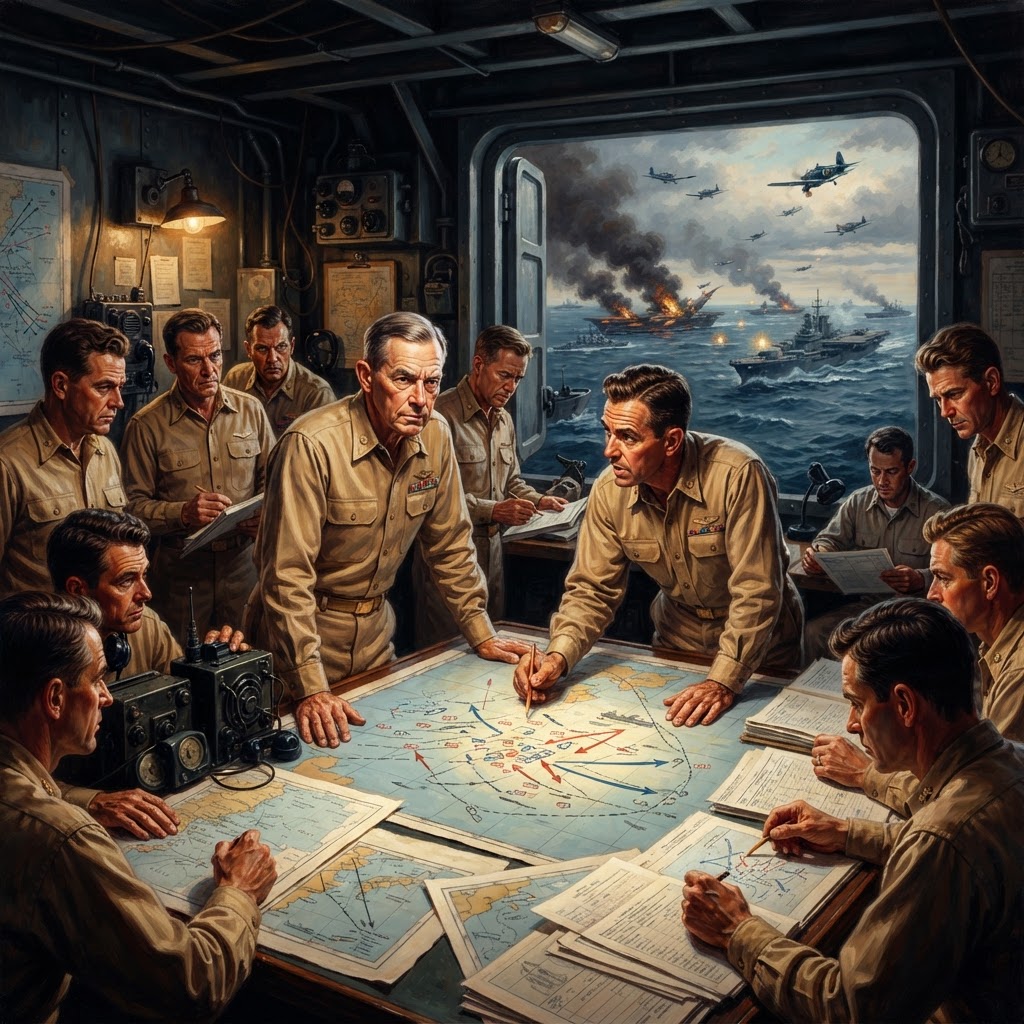
The Battle of Midway (June 4–7, 1942) remains the most significant naval engagement of the Pacific Theater in World War II. While often remembered for the sheer scale of the carrier battle, the victory was fundamentally a result of superior intelligence, calculated risk-taking, and the aggressive command decisions of Admiral Chester Nimitz and his task force commanders. This article analyzes the operational risks taken to ambush the Imperial Japanese Navy and the impact of decentralized command on the outcome.
Key Points
- Intelligence Advantage: The breaking of the Japanese naval code (JN-25) allowed the U.S. to anticipate the attack, turning a defensive posture into a strategic ambush.
- Calculated Risk: Admiral Nimitz’s decision to commit all available carriers to the defense of Midway, despite the uncertainty of the Japanese fleet's exact location, was a high-stakes gamble that paid off.
- Decentralized Execution: The battle demonstrated the necessity of empowering subordinate commanders to make rapid decisions when communication with the flagship was disrupted.
- The Turning Point: The destruction of four Japanese fleet carriers effectively ended Japan's offensive capability in the Pacific, shifting the strategic initiative to the United States.
Sources
- Wikipedia: Battle of Midway (https://en.wikipedia.org/wiki/Battle_of_Midway)