The Tuskegee Airmen and the Record They Built
October 3, 2026
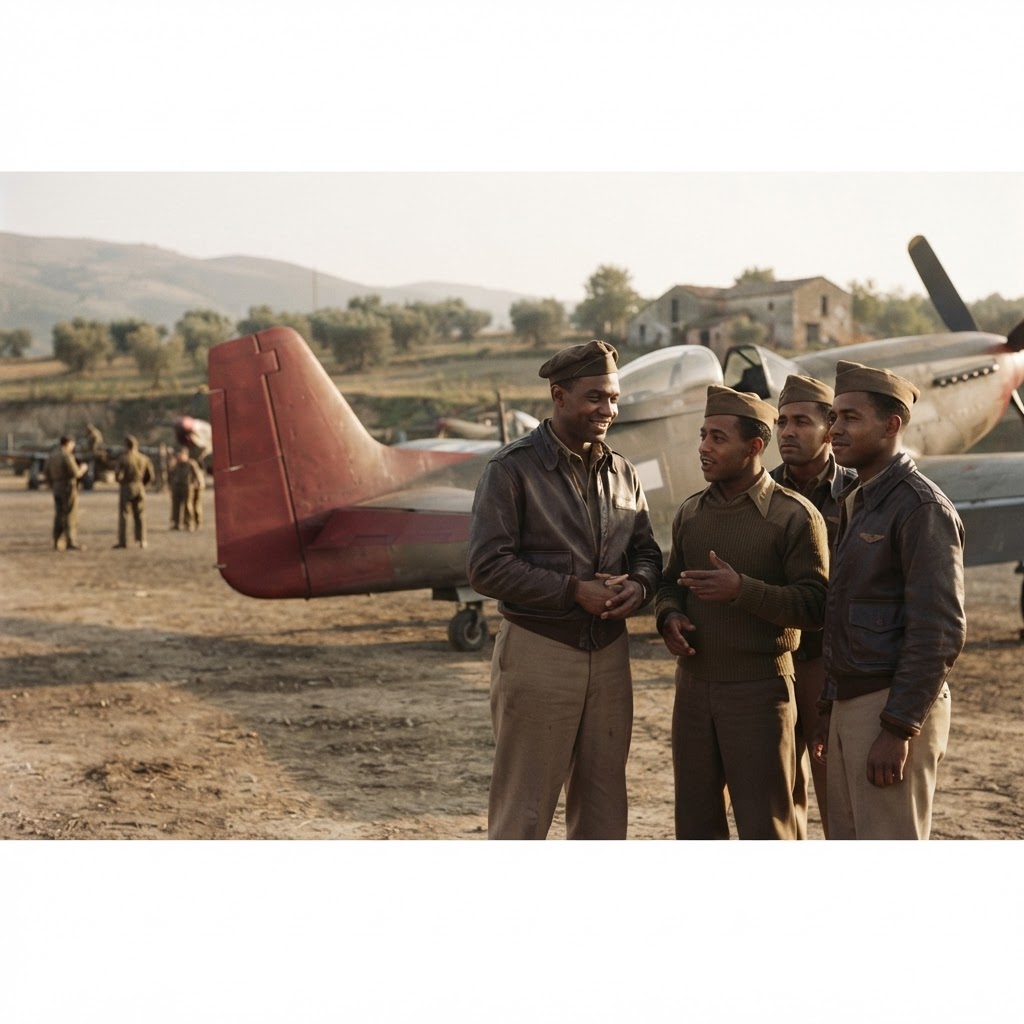
In the face of systemic institutional exclusion, the men of the 332nd Fighter Group forged a record of professionalism that transformed the United States Army Air Forces and accelerated the path toward military desegregation.
The Burden of Institutional Bias
The path for the Tuskegee Airmen was not merely obstructed by personal prejudice; it was codified by institutional policy. In 1925, the U.S. Army War College produced a study titled "The Use of Negro Manpower in War." The document concluded that African Americans were physically and mentally unfit for combat, specifically lacking the coordination and courage required for aviation. This assessment served as the official justification for the exclusion of Black pilots from the Army Air Corps for over a decade.
When the political pressure to integrate increased, the War Department maintained this stance of skepticism. Even as the Tuskegee program was established in 1941, it was viewed by many senior officials as an experiment destined to fail. The training program at Tuskegee Army Air Field eventually produced roughly 990 pilots. These men were drawn from a pool of approximately 15,000 personnel, including navigators, bombardiers, mechanics, and administrative staff who were denied the opportunity to serve in their specialties due to their race.
Establishing the Standard: Colonel Benjamin O. Davis Jr.
Success for the Tuskegee units was not merely a matter of tactical proficiency; it was a matter of survival in a hostile environment. Colonel Benjamin O. Davis Jr., a graduate of West Point and the primary commander of the 99th Fighter Squadron and later the 332nd Fighter Group, understood that his men were operating under a microscope.
Davis implemented a standard of discipline that exceeded the requirements of the Air Force. He enforced strict grooming standards, rigorous aircraft maintenance protocols, and precise formation flying. He recognized that any lapse in judgment or discipline would be used by critics to validate the 1925 War College study. By insisting that his pilots be the most professional airmen in the theater, Davis created a unit that was undeniably effective, making it increasingly difficult for the institutional hierarchy to ignore their capabilities.
Combat Operations and the Red Tails
The 99th Fighter Squadron first deployed to North Africa in 1943, later moving into Italy. They were eventually joined by the 101st, 302nd, and 301st Fighter Squadrons to form the 332nd Fighter Group. Throughout the Italian campaign, the 332nd served as part of the Fifteenth Air Force, tasked primarily with escorting heavy bombers during long-range raids over Europe.
To facilitate easier identification in the air, the group’s P-51 Mustangs were painted with distinctive red tails. This marking became a symbol of their presence over the skies of Germany, Austria, and beyond. Over the course of the war, pilots of the 332nd were credited with destroying 112 enemy aircraft in aerial combat and damaging or destroying an additional 273 on the ground. For their actions, the 332nd Fighter Group received the Distinguished Unit Citation for their successful escort mission to Berlin on March 24, 1945.
Addressing the Myth of the "Invincible Escort"
In the decades following World War II, a narrative emerged claiming that the 332nd Fighter Group never lost a bomber to enemy aircraft during their escort missions. This legend became a central part of the unit’s legacy. However, a 1995 study by the U.S. Air Force Historical Research Agency examined mission reports and loss records, concluding that the unit did, in fact, lose bombers while under their protection.
The study compared the loss rates of the 332nd against other escort groups and found that the performance of the Tuskegee Airmen was comparable to their counterparts in the Fifteenth Air Force. While the "never lost a bomber" claim is factually unsupported, the myth itself speaks to the magnitude of the pressure placed upon the unit. The story took hold because the unit’s success was, for many, the only evidence that an integrated military could function. Their actual performance was exemplary by any military metric; it did not require the embellishment of a myth to demonstrate their vital role in the strategic air campaign.
The Institutional Fight: Freeman Field and Desegregation
The fight for equality did not conclude upon the return to American soil. In 1945, the Army Air Forces attempted to enforce segregation within officer clubs at Freeman Field, Indiana. When Black officers from the 477th Bombardment Group attempted to enter an "all-white" club, they were arrested for insubordination.
The ensuing controversy, which resulted in the dismissal of the base commander and the eventual clearing of the officers’ records, highlighted the friction between the wartime reality of integrated combat and the domestic policy of institutional segregation. This persistent advocacy, combined with the proven combat record of the 332nd, forced a re-evaluation of the military’s personnel policies. In 1948, President Harry S. Truman signed Executive Order 9981, officially mandating the desegregation of the U.S. Armed Forces.
Lessons in Excellence and Resilience
The history of the Tuskegee Airmen offers a complex lesson in leadership and organizational dynamics. These men operated within an institution that had formally codified their inferiority and actively sought to limit their potential. Yet, they responded with unwavering professionalism.
The core leadership lesson from the Tuskegee experience is the power of setting an undeniable standard. By focusing on technical mastery, discipline, and unit cohesion, the 332nd Fighter Group forced the institution to confront its own contradictions. They demonstrated that excellence is not merely an individual trait but a collective capability that, when executed under extreme scrutiny, can dismantle even the most entrenched systemic biases. For modern leaders, their legacy serves as a reminder that the best way to challenge institutional doubt is to ensure that your work, your conduct, and your results leave no room for skepticism. They did not just fly planes; they navigated a landscape of institutional resistance with a precision that changed the structure of the American military forever.