Mary Edwards Walker: The Medal and the Cost of It
October 3, 2026
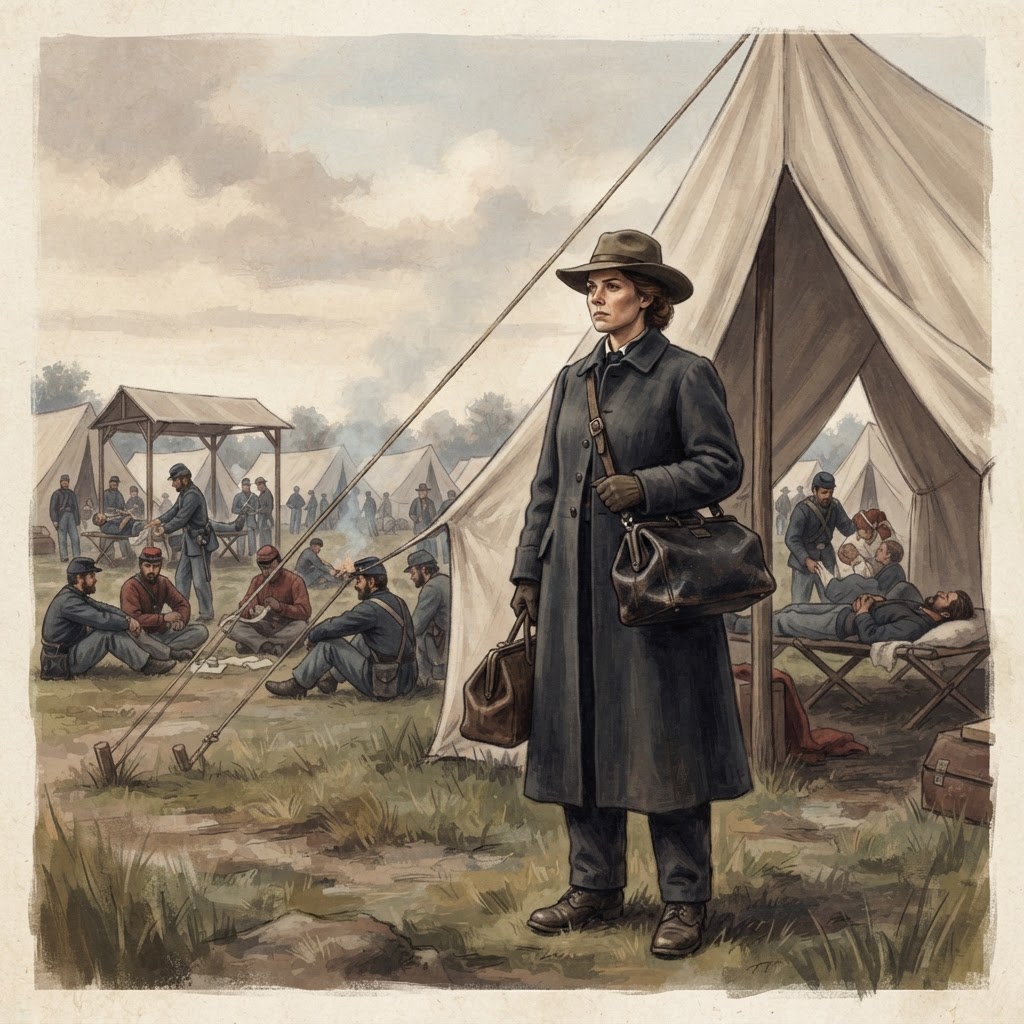
A profile of the surgeon who navigated the rigid boundaries of nineteenth-century military bureaucracy to serve on the front lines of the American Civil War.
An Education in Defiance
Mary Edwards Walker was born on November 26, 1832, in Oswego, New York. Raised in a family that valued education and progressive reform, she pursued a career in medicine at a time when the field was almost exclusively male. She enrolled at the Syracuse Medical College and graduated in 1855, one of the few women in the United States to hold a medical degree at that time.
Following her graduation, she established a private practice in Columbus, Ohio, and later in Rome, New York. In 1855, she married fellow physician Albert Miller. True to her lifelong commitment to individual autonomy, she insisted on keeping her own surname and refused to include the word "obey" in their wedding vows. These early markers of her independence foreshadowed the challenges she would face when attempting to integrate into the structured, hierarchical world of military medicine.
The Bureaucratic Barrier
When the American Civil War began in 1861, Walker sought to contribute her professional skills to the Union cause. She traveled to Washington, D.C., and applied for a commission as an army surgeon. The military authorities rejected her application, citing that there was no provision for a woman to serve in the Medical Corps.
Unfazed by this formal exclusion, Walker opted to serve as a volunteer. She worked in temporary hospitals in Washington and on the front lines at the First Battle of Bull Run in July 1861. Her persistence eventually yielded a degree of official recognition. In 1863, she was employed as a contract acting assistant surgeon with the Army of the Cumberland. She was the first woman to hold this position, serving under General George H. Thomas. Her duties took her to the field at Chickamauga and Chattanooga, where she treated wounded soldiers under the same conditions as her male counterparts.
Captivity and Exchange
The realities of Civil War service extended beyond the operating table. In April 1864, while performing her medical duties near the front lines, Walker was captured by Confederate forces. She was subsequently transported to Richmond, Virginia, and imprisoned. She spent approximately four months in captivity, a period characterized by the hardships and deprivations common to prisoners of war during that conflict.
Following her release in a prisoner exchange in August 1864, Walker returned to service. She was assigned to a women’s prison hospital in Louisville, Kentucky, and later served at an orphanage in Tennessee. Her service record during this period reflects the necessity of medical labor in the wake of significant combat operations, despite the lack of official military status that her male colleagues enjoyed.
Formal Recognition and Public Contention
In November 1865, President Andrew Johnson presented Mary Edwards Walker with the Medal of Honor. The citation noted her meritorious service and her dedication to the Union. However, her life remained defined by friction with established norms. Outside of her military service, she became a prominent figure in the dress reform movement, arguing that traditional female clothing was physically restrictive and unhealthy.
Her advocacy for women’s rights and her practice of wearing men’s clothing—including trousers and a frock coat—often invited public scrutiny and legal trouble. In 1866, she was arrested in New York City for impersonating a man, an indicator of the societal hostility toward her challenges to gender-based dress codes.
The Erasure and Restoration
The military’s recognition of Walker proved to be fragile. In 1917, the United States government established a review board to examine the legitimacy of previously issued Medals of Honor. As part of a broader effort that stripped hundreds of other recipients of their awards, the board struck Walker’s name from the official roll, citing that she had not been a commissioned officer at the time of her service.
Walker vehemently rejected the board’s decision. She continued to wear her medal daily until her death in 1919, maintaining that her service was deserving of the honor regardless of bureaucratic reclassification. It was not until 1977, following a petition by her descendants, that President Jimmy Carter signed an executive order restoring her Medal of Honor, officially rectifying the 1917 decision.
Lessons in Moral Authority
Mary Edwards Walker’s career offers complex lessons for the modern leader. Her service highlights the difficulty of operating within an institution that refuses to provide formal validation for one’s contributions. Walker demonstrated that professional excellence can persist even when the structures designed to govern that excellence are exclusionary.
Her life illustrates a profound distinction between formal authority and moral authority. While the Army withheld a commission, her actions in the field provided a form of moral authority that could not be retracted by a board of review. Leaders often operate in environments where their institutional standing is contested or unrecognized. In such cases, the burden of leadership shifts toward the consistency of one's performance and the integrity of one’s convictions.
Finally, the arc of her recognition—from commission refusal to award, to erasure, and finally to restoration—serves as a reminder that history is an active process of correction. Institutions are static, but the appraisal of leadership is dynamic. The recognition withheld in one era is often salvaged by the historical perspective of the next, confirming that those who blaze paths for others frequently do so at the cost of their own temporary institutional standing.