Mobilizing the Arsenal of Democracy: US Commercial Industry & Government in World War II — Full Analysis
Full Content FreeOctober 6, 2026

Mobilizing the Arsenal of Democracy: US Commercial Industry & Government in World War II
Executive Summary
Between 1939 and 1945, the United States executed the most consequential industrial mobilization in history. A nation emerging from the Great Depression — factories idle, unemployment near 15%, the military ranked 17th in the world behind Portugal — transformed itself into the "Arsenal of Democracy," producing over 300,000 aircraft, 86,000 tanks, 2 million military trucks, 6,771 large ships, and 41 billion rounds of ammunition. This required an unprecedented partnership between the federal government and private industry, mediated through new agencies, innovative contracts, and the systematic conversion of civilian manufacturing to war production. The story — its triumphs, failures, and structural tensions — offers enduring lessons for any nation confronting industrial-scale warfare in the 21st century.
Strategic & Political Context
The Pre-War Baseline
In 1939, the U.S. possessed a vast but underutilized industrial base. Between the Wright brothers' first flight (1903) and the Nazi invasion of Poland (September 1939), American companies had produced only ~30,000 aircraft of all types. The country had just three suppliers of high-performance aircraft engines. On May 26, 1940 — as British forces evacuated Dunkirk — Roosevelt addressed Congress, calling for $1.1 billion to rearm and declaring: "I should like to see this nation geared up to produce at least fifty thousand planes a year." The War Department had not been consulted. The goal was aspirational — but it galvanized action.
The Institutional Architecture
- NDAC (May 1940): Advisory board including William S. Knudsen (GM executive VP). Lacked enforcement authority. Helped launch a $9 billion expansion program.
- OPM (December 1940): Replaced NDAC with directing authority. Knudsen as director; Sidney Hillman represented labor. Still hamstrung by competing power centers.
- WPB (January 16, 1942): Chaired by Donald M. Nelson, granted "supreme authority to assure maximum production and procurement for war." Directed industry conversion, allocated scarce materials, set priorities. Directed ~$185 billion in armaments.
- OWM (May 1943): Led by James F. Byrnes as War Mobilization Director, with authority to resolve inter-agency disputes — a role painfully absent since 1940.
- DPC (August 1940): Subsidiary of the Reconstruction Finance Corporation (RFC), financing new industrial facilities under the government-owned, contractor-operated (GOCO) model.
- SWPC (June 1942): Smaller War Plants Corporation, created to integrate small businesses into war production.
The DPC and the GOCO Model
The DPC, operating under RFC chairman Jesse Jones, financed plant construction, retained government title, and leased facilities to private operators. Executive VP John W. Snyder recalled: "We advanced over $11 billion [to build] plants. We built all the synthetic rubber plants, all the magnesium plants, and aluminum plants." By war's end, the DPC owned 10–12% of the country's entire industrial capacity — accounting for 96% of synthetic rubber, 90% of magnesium, 71% of aircraft/engine, and 58% of aluminum production.
Order of Battle: Key Players
Government
| Official | Role | Contribution | |---|---|---| | Franklin D. Roosevelt | President | Set visionary production goals; created mobilization architecture | | William S. Knudsen | NDAC/OPM | Brought automotive mass-production expertise; recruited industry leaders | | Donald M. Nelson | WPB Chairman | Directed conversion and allocation; held "supreme authority" | | James F. Byrnes | OWM Director | Coordinated competing agencies; resolved disputes | | Jesse Jones | RFC Chairman | Controlled DPC financing; negotiated GOCO arrangements | | Leon Henderson | OPA Administrator | Managed rationing, price controls, civilian auto ban |
Industry
| Company | Conversion | Key Output | |---|---|---| | Ford Motor Co. | Cars → B-24 bombers (Willow Run) | 8,685 B-24 Liberators; one every 63 min at peak | | General Motors | Cars → Tanks, trucks, engines | 250,000+ military trucks; tank production across divisions | | Chrysler Corp. | Cars → Tanks (Detroit Arsenal) | 3,352 M3 + 17,947 M4 Sherman tanks; 25,000+ total | | Henry J. Kaiser | Construction → Shipbuilding | ~1,500 Liberty/Victory ships; build time from 200+ days to 4 days | | Boeing | Aircraft → Mass bomber production | B-17 Flying Fortress; B-29 Superfortress | | Higgins Industries | Small boats → Landing craft | 20,000+ LCVP "Higgins Boats" | | Grumman | Naval aircraft | F4F Wildcat, F6F Hellcat, TBF Avenger |
Phase-by-Phase Breakdown
Phase 1: Recognition (May–December 1940)
Knudsen toured the country cataloging industrial capacity and identifying convertible firms. The NDAC's voluntarist approach — appealing to patriotism — was hampered by lack of authority and executive resistance. The DPC began financing plants, but Jones's insistence on personally approving deals created bottlenecks. Many financiers hesitated to invest in a war they believed might never come.
Phase 2: Pearl Harbor & Conversion (December 1941 – February 1942)
Pearl Harbor eliminated all ambiguity. On January 2, 1942, Nelson froze automobile sales. On February 1, civilian auto production was banned entirely — the industry that had produced 5 million vehicles in 1941 pivoted to war. UAW president R. J. Thomas criticized the delay: "We proposed [the decision] a year ago. We did not get far."
Simultaneously, Japan's conquest of the Dutch East Indies cut off 90% of America's natural rubber. The WPB expanded the synthetic rubber program (400,000+ ton goal by 1943), with the DPC financing all plants and the Rubber Reserve Company coordinating research among competing firms — an extraordinary government-orchestrated technology-sharing initiative.
Phase 3: Full-Scale Production (1942–1943)
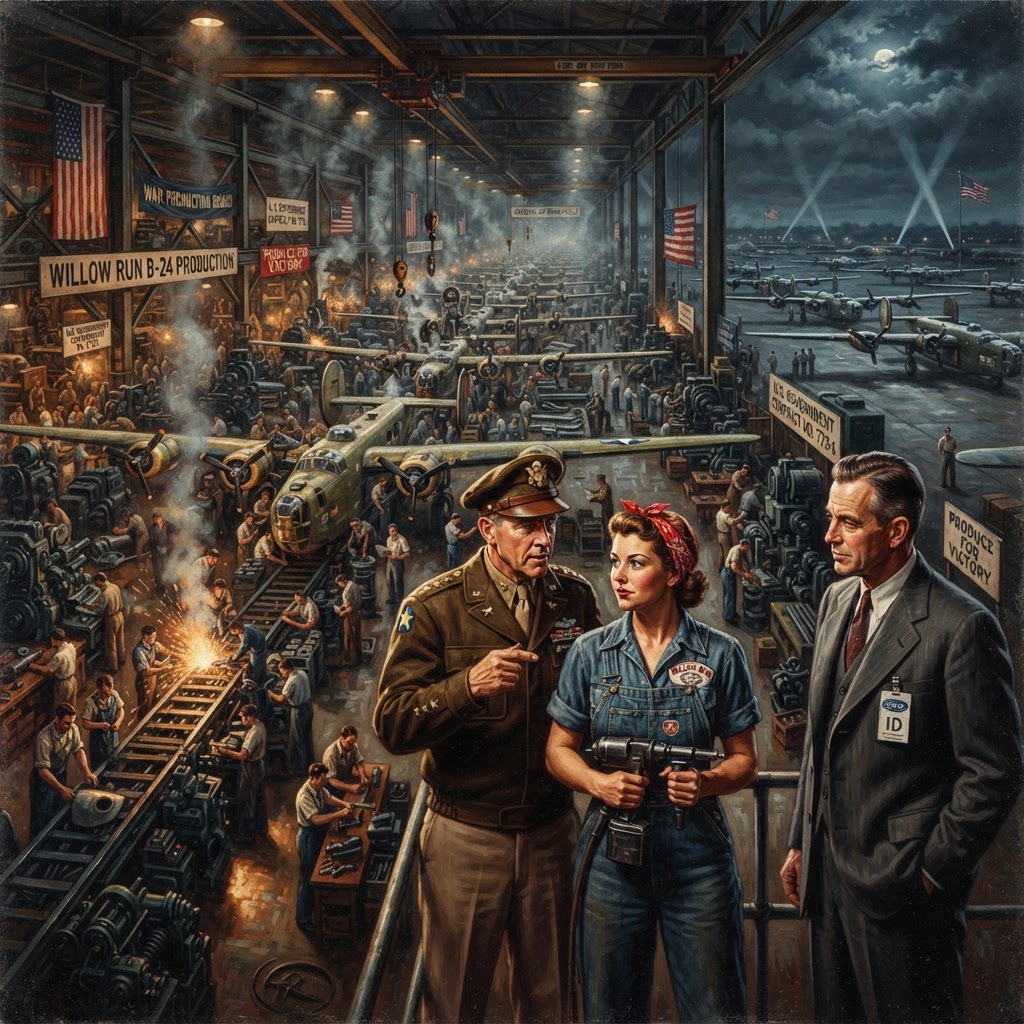
- Willow Run: 3.5 million sq ft — largest factory under one roof. First B-24 on May 15, 1942. Peak: one every 63 minutes. Total: 8,685 Liberators.
- Detroit Arsenal: First GOCO tank plant. First M3 delivered April 24, 1941 (pre-Pearl Harbor). Peak output June 1944. Total: 25,000+ tanks.
- Kaiser shipyards: Prefabrication and assembly-line techniques. Construction time dropped from 200+ days to an average of 42 days. Record: SS Robert E. Peary — 4 days, 15 hours, 30 minutes.
- Scrap drives: 4+ million junked cars yielded ~3 million tons of iron/steel scrap. Processing rate: 450,000 jalopies/month; turnover cut from 7 months to <45 days.
Phase 4: Peak Output (1943–1944)
Total government expenditure: $337 billion (~$6 trillion in 2026 dollars). Peak aircraft production in 1944: 96,270 planes. The OWM under Byrnes finally provided coordinating authority. The excess profits tax was remarkably effective: the 50 largest corporations paid ~$8.25 billion in a single year. Total federal receipts rose from $6.2 billion (1940) to $35.8 billion.
Phase 5: Demobilization (1945)
WPB dissolved. GOCO plants offered for sale to operators, sold to other firms, or decommissioned. The GOCO model survived in the Department of Energy's national laboratory system.
Positives: What the Mobilization Got Right
1. The GOCO Model and Risk Allocation: Government retained title to facilities while leasing them to private operators — separating asset risk (borne by government) from operational risk (borne by industry). This made strategic investment compatible with private profit maximization. Private firms would not invest billions in specialized defense capacity without shared risk.
2. Mass-Production Innovation: Applying automotive assembly-line techniques to aircraft (Ford's Willow Run), shipbuilding (Kaiser's prefabrication), and armor (Chrysler) was revolutionary. The idea that complex aircraft could be assembled like automobiles doubled or tripled production rates and permanently transformed industrial engineering.
3. Public-Private Technology Sharing: The synthetic rubber program demonstrated government could orchestrate technology sharing among competitors. The Rubber Reserve Company pooled patents and know-how across major chemical companies, going from zero to 700,000+ tons/year — impossible without government coordination of intellectual property.
4. Workforce Mobilization: 6+ million women entered the industrial workforce ("Rosies"). Women in manufacturing rose from 10% to 30%. The government invested in training, childcare, and recruitment.
5. Anti-Profiteering Measures: The excess profits tax and Renegotiation Act (1942) recovered billions while allowing reasonable returns — demonstrating that massive government spending need not mean massive profiteering.
6. Geographic Dispersal: War production was deliberately spread across 44 states and 1,375 cities, creating a distributed industrial base inherently more resilient than a concentrated one.
Negatives: What the Mobilization Got Wrong
1. Slow Initial Mobilization: The 18 months from May 1940 to December 1941 were characterized by delay, hesitation, and bureaucratic infighting. Private firms resisted abandoning profitable civilian production. Jones's personal approval bottleneck slowed DPC programs. The country lost critical preparation time.
2. Bureaucratic Fragmentation: The proliferation of agencies (NDAC, OPM, WPB, OWM, OPA, WMC, SWPC, DPC, Rubber Reserve) created constant jurisdictional disputes. It took until May 1943 — 18 months after Pearl Harbor — for Byrnes to receive overarching authority.
3. Exclusion of Small Business: Despite the SWPC, small firms were largely marginalized. Prime contracts went to large corporations. Many small manufacturers were shut out entirely when civilian markets disappeared and they lacked capital to retool, accelerating industrial consolidation.
4. Racial and Gender Inequality: African Americans were systematically excluded from skilled positions until A. Philip Randolph's threatened March on Washington forced Executive Order 8802 (June 1941). Even then, enforcement was uneven. ~600,000 Black women worked in war industries but were concentrated in the lowest-paying, most dangerous jobs. Japanese Americans were incarcerated; their businesses seized.
5. Waste and Inefficiency: Cost-plus contracts incentivized cost inflation — contractors' absolute dollar profits rose with costs. The Renegotiation Act partially addressed this, but billions were wasted on superseded, canceled, or redundant programs. Early Liberty ships suffered brittle fracture in cold Atlantic waters, causing catastrophic hull failures.
6. Concentration of Political Power: Jones's RFC control allowed billions to be disbursed bypassing congressional appropriations — tremendous political power with little accountability. His personal deal-making allowed incumbents to stifle competition and slowed the pre-Pearl Harbor program.
7. Civilian Economic Disruption: Auto production bans, tire/gas/food rationing, and consumer goods freezes imposed significant hardship. The abruptness — particularly the February 1942 auto ban — could have been mitigated by earlier planning and a phased approach.
Key Decision Points
- Roosevelt's 50,000-Plane Goal (May 1940): Made without War Department consultation — a strategic bluff that catalyzed institutional architecture.
- Civilian Auto Ban (Feb 1, 1942): Freed the nation's largest industrial sector for military conversion. Should have been made 12 months earlier.
- The GOCO Model (1940–1941): Incremental, driven by RFC lending authority and private firms' reluctance — not a coherent strategy but an ad hoc response that became the mobilization's foundation.
- OWM Creation (May 1943): Concession to the reality that coordination requires centralized authority.
- Executive Order 8802 (June 1941): First federal action against employment discrimination, forced by Randolph's threatened March on Washington.
Lessons Learned & Modern Application
Lesson 1: Mobilization Takes Years, Not Months. Even with total war urgency, it took May 1940 to mid-1943 — three years — to reach peak coordinated output. Modern application: Any serious mobilization plan for a potential peer conflict must begin years before hostilities. The Defense Production Act exists but is insufficient without pre-positioned institutional capacity, identified surge facilities, and stockpiled critical materials.
Lesson 2: Government Must Bear Asset Risk. Private firms will not invest billions in specialized defense capacity that may be worthless in peacetime. The GOCO model was the key. Modern application: DoD's reliance on private capital for defense production capacity is structurally fragile. A modern DPC equivalent — or expanded Defense Production Act Title III use — could finance surge capacity in munitions, shipbuilding, semiconductors, and rare earth processing.
Lesson 3: Unified Civilian Authority Is Essential. Agency proliferation caused constant friction. Not until Byrnes received overarching authority did coordination improve. Modern application: Large-scale mobilization requires a single empowered coordinator with authority to resolve disputes between Pentagon, industry, labor, and civilian agencies.
Lesson 4: Cross-Industry Knowledge Transfer Drives Innovation. The most successful conversions came from applying one industry's techniques to another (automotive → aircraft, shipbuilding, armor). Modern application: Applying commercial mass-production to drones, munitions, and electronics remains underexploited.
Lesson 5: Anti-Profiteering Measures Must Not Strangle Incentives. The excess profits tax and Renegotiation Act recovered billions while allowing reasonable returns — but cost-plus contracts incentivized inefficiency. Modern application: Use fixed-price incentives where possible, with renegotiation authority for cost-plus arrangements.
Lesson 6: Workforce Mobilization Requires Deliberate Investment. Rapid workforce expansion required massive investment in training, childcare, housing, and transportation. Modern application: A modern mobilization requires workforce strategy including vocational training, immigration reform for skilled labor, and retention policies.
Lesson 7: Small Business Integration Requires Active Intervention. The SWPC was created too late and with too little authority. Modern application: Modern planning must actively integrate small and medium-sized manufacturers into defense supply chains as independent producers, not just subcontractors.
Lesson 8: Government-Orchestrated Technology Sharing Can Overcome Market Failure. The synthetic rubber program proved government can coordinate IP sharing among competitors when national security demands it. Modern application: In AI, advanced manufacturing, and semiconductors, government could pool intellectual property, facilitate joint research, and underwrite risk.
Lesson 9: Pre-Planning Is Irreplaceable. The 18 months between Roosevelt's speech and Pearl Harbor were largely wasted — no pre-existing plans, identified facilities, trained workforce pipelines, or stockpiled materials. Modern application: The Pentagon and FEMA should maintain living mobilization plans — updated annually, exercised, not merely filed.
Lesson 10: Political Will Is the Ultimate Constraint. Every mobilization failure — slow start, bureaucratic infighting, conversion resistance — was fundamentally a failure of political will. Modern application: Industrial mobilization will not happen without presidential-level commitment, public communication of stakes, and willingness to override institutional resistance. The technical solutions exist; the political will to implement them does not.
Legacy & Historical Significance
The WWII industrial mobilization fundamentally reshaped the American economy and global strategic landscape. It established the U.S. as the world's preeminent industrial power, created the modern military-industrial complex, demonstrated the viability of government-industry partnership at scale (influencing the Marshall Plan, Interstate Highway System, Space Program, and DARPA/internet), advanced social progress through women's and minorities' workforce entry (though incomplete), and created institutional templates — the GOCO model, cost-plus contracting, renegotiation authority, excess profits taxation — that remain in use today.
It also left a darker legacy: permanent expansion of executive economic power, industrial concentration among few large corporations, and normalization of deficit spending. The Defense Production Act (1950), modeled directly on the wartime experience, remains the primary legal authority for industrial mobilization — invoked most recently during the COVID-19 pandemic.
Bibliography
- Rhode, Snyder & Strumpf. "The Arsenal of Democracy: Production and Politics During WWII." NBER Working Paper No. 24158, December 2017.
- Helwig, Brady. "When the Government Owned Factories: The Defense Plant Corporation and Its Lessons for Today." American Affairs Journal, Spring 2026.
- Wilson, Mark R. Destructive Creation: American Business and the Winning of World War II. Univ. of Pennsylvania Press, 2016.
- Herman, Arthur. Freedom's Forge: How American Business Produced Victory in World War II. Random House, 2012.
- Koistinen, Paul A.C. Arsenal of World War II: The Political Economy of American Warfare, 1940–1945. Univ. Press of Kansas, 2004.
- Nelson, Donald M. Arsenal of Democracy: The Story of American War Production. Harcourt, Brace, 1946.
- U.S. Office of War Mobilization. Report to the Nation on War Production. GPO, 1942–1945.
- U.S. Naval History and Heritage Command. "Gearing Up for Victory: American Military and Industrial Mobilization."
- U.S. War Production Board. War Production in 1942. GPO, 1943.
- Cancian, Mark F. "Industrial Mobilization." CSIS Report, 2021.
- CSBA. "Arsenal of Democracy: Myth or Model? Lessons for 21st-Century Industrial Mobilization Planning."
- National WWII Museum. "Rosie the Riveter: Women War Workers on the WWII Home Front."
- Defense Media Network. "Automobile Factories Switched to War Production." January 2022.
- U.S. National Archives. Records of the Reconstruction Finance Corporation, RG 234.
- U.S. GPO. Victory: Official Weekly Bulletin of the Office for Emergency Management. January 6, 1942.